|
Size: 4181
Comment:
|
Size: 6630
Comment:
|
| Deletions are marked like this. | Additions are marked like this. |
| Line 1: | Line 1: |
| #acl LcnGroup:read,write,delete,revert All: ''This page is readable only by those in the LcnGroup.'' |
|
| Line 3: | Line 6: |
| '''''Contributors:''''' ''Bruce Fischl (BF), Doug Greve (DG), Andrew Hoopes (AH), Oula Puonti (OP), Nick Schmansky (NS), Koen Van Leemput (KVL)'' | '''''Contributors:''''' ''Nick Schmansky (NS), Christian Larsen (CL), Bruce Fischl (BF), Doug Greve (DG), Andrew Hoopes (AH), Bram Diamond (BD), Oula Puonti (OP), and Koen Van Leemput (KVL)'' |
| Line 5: | Line 8: |
| Total intracranial volume (TIV/ICV) is an important covariate for volumetric analyses of the brain and brain regions, where it can provide a proxy of brain volume. It is commonly used to correct for head size variation (ie. 'normalize' hippocampal volume size). The gold-standard method is manual delineation of T2 scans. Freesurfer provides its eTIV measure, [[eTIV|described on this page]], but the approach suffers from its indirect approach: alignment to a T1w atlas, and not by direct segmentation of skull. | Total intracranial volume (TIV/ICV) is an important covariate for volumetric analyses of the brain and brain regions, where it can provide a proxy of brain volume. It is commonly used to correct for head size variation (ie. 'normalize' hippocampal volume size). The gold-standard method is manual delineation of T2 scans. Freesurfer provides its eTIV measure, [[eTIV|described on this page]], but the approach suffers from its indirect approach: alignment to a T1w atlas, and not by direct segmentation of all structures within the skull boundaries. |
| Line 12: | Line 15: |
| * [[attachment:TIV-Malone-NeuroImage-Jan2015-supl.pdf|Supplementary data]] | |
| Line 13: | Line 17: |
| Our segmentation-based estimate of total intracranial volume, sbTIV, attempts to provide the measure making use of the skull segmentation output by the [[Samseg]] processing stream. The freesurfer utilities '''mri_sbTIV''' and '''mri_segstats''' both provide this measure, where a skull segmentation volume is provided as input. | Our segmentation-based estimate of total intracranial volume, sbTIV, attempts to provide the measure making use of the structures segmented by the [[Samseg]] processing stream which fill the skull (intracranial volume). |
| Line 17: | Line 21: |
| {{{ mri_sbTIV --i <skullsegvol> [--o <file>] }}} mri_sbTIV accepts a binary volume where 1 indicates skull and 0 is empty. It determines the TIV by '''''insert brief description of algorithm here''''' and outputs to stdout the estimate in mm3 (and optionally to the text file named by <file>). Note that mri_sbTIV development is based on a skull segmented by Samseg, but in principle could accept any skull segmentation volume. |
Upon completion of samseg, the file samseg.stats is produced, which contains the (probabilistic weighed) volumes of each labeled structure. An example is: |
| Line 23: | Line 24: |
| mri_segstats --skullseg <skullsegvol> ... | # Measure Soft_Nonbrain_Tissue, 987441.150308, mm^3 |
| Line 25: | Line 28: |
| When a skull segmentation is provided to mri_segstats, the same estimation provided by the algorithm underlying mri_sbTIV is used to insert an additional measure of brain volume to its output summary file. From its help file: | The utility sbtiv takes samseg.stats as an input together with an optional list of structure names that define intracranial volume. Names within the list must correspond to those used within the atlas used by samseg. sbtiv then outputs sbtiv.stats, which contains the intracranial volume (a sum over volumes, given the provided map). An example output is: {{{ # Measure Intra_Cranial_Volume, 160000.123456, mm^3 }}} Commandline arguments for sbtiv can be found by running sbtiv with the --help parameter. Additionally... {{{ mri_segstats --sbTIVin <sbtiv.stats> ... }}} When <sbtiv.stats> is provided to mri_segstats, the sbTIV measure is read and added as an additional measure of brain volume to its output summary file. From its help file: |
| Line 28: | Line 43: |
| based on a skull segmentation. See surfer.nmr.mgh.harvard.edu/fswiki/sbTIV | based on the Samseg-based segmentation. See surfer.nmr.mgh.harvard.edu/fswiki/sbTIV |
| Line 32: | Line 47: |
| # Measure sbTotalIntracranialVolume, sbTIV, segmentation-based estimated Total Intracranial Volume, 1667606.252292, mm^3 | # Measure sbTotalIntracranialVolume, sbTIV, samseg-based estimated Total Intracranial Volume, 1667606.252292, mm^3 |
| Line 36: | Line 51: |
| == Method == The Samseg-based segmentation data includes a labeling of all voxels inside the skull. This is in contrast to the older FreeSurfer .gca -based atlas, which was limited to brain structures which did fully 'fill' the skull. Samseg's labeling of intracranial voxels means that its ICV estimate in principle is immune to shrinking brain structures (where the .gca -based structures do not contain labels allowing immunity to this effect). This is a critical characteristic of an ICV estimate, particularly important in measuring structures in an aging population, where ICV does not change with age, but many structures shrink. The method sums the following structures: '''TBD''' |
|
| Line 37: | Line 59: |
| The mri_sbTIV measure was validated against these reference sources: | The sbTIV measure was validated against these reference sources: |
| Line 40: | Line 62: |
| ||SASHA||22 subjects, manual TIV from T2 scans|| ||ADNI_T2||42 subjects, manual TIV from T2 scans|| ||Buckner40||40 subjects, eTIV from FS v6.0|| ||ADNI60||60 subjects, eTIV from FS v6.0|| |
||SASHA||22 subjects, manual TIV from Buckner/OASIS T2 scans|| ||ADNI_T2TCV||[[attachment:ADNI_Total_Cranial_Vault_Segmentation_Method_20121108.pdf|300 (grade 3) subjects, verified Total Cranial Vault (TCV) segmentations from T2 scans]],[[attachment:TCV_DICT.csv|TCV_DICT.csv]], [[attachment:TCV.csv|TCV.csv]]|| ||Buckner40||40 subjects, eTIV from FS v6.0, and SPM12|| ||ADNI60||60 subjects, eTIV from FS v6.0, and SPM12|| |
| Line 46: | Line 68: |
| ||IXI_79||70 subjects, eTIV from FS v5.3|| | ||IXI79||70 subjects, eTIV from FS v5.3, and SPM12|| [[https://www.jiscmail.ac.uk/cgi-bin/webadmin?A2=spm;a19cf780.1505|This link has notes on generating the ICV measure in SPM12.]] [[http://www.fil.ion.ucl.ac.uk/~john/misc/VBMclass15.pdf|...and this paper.]] [[https://github.com/neurodebian/spm12/blob/master/config/spm_run_tissue_volumes.m|...and this matlab file.]] |
| Line 50: | Line 76: |
| The SASHA and ADNI_T2 datasets support the primary validation efforts, as this data is based on expert manual segmentations. The other datasets compare against the freesurfer eTIV of nearly 2000 subjects. | The SASHA and ADNI_T2TCV datasets are the primary validation sources, as is based on expert manual segmentation of T2 data (SASHA) and manual verification of T2-based segmentation (ADNI_T2TCV). The other datasets compare against the freesurfer eTIV of nearly 2000 subjects, and SPM12 eTIV from 179 subjects. == Results == === Manual segmentations === || {{attachment:sasha.png}} || {{attachment:adni30.png}} || === Method performance === As a secondary validation measure, correlations and absolute % difference in measured ICV were computed for a pairwise rotation of freesurfer 6.0, spm 12 and samseg, to explore to what extent the methods 'agree' with each other. || Dataset || FS 6 vs spm12 || samseg vs FS || samseg vs spm12 || || ADNI30 || r=0.922, diff=6.588% || r=0.975, diff=2.697% || r=0.961, diff=4.131% || |
| Line 57: | Line 94: |
| * AH,KVL,OP - generate skull_seg.mgz output from current T1-based Samseg stream * AH - copy SASHA and ADNI_T2 datasets to samsseg/subjects dirs from locations shown in [[eTIV]] page * AH - create validation scripts, whereby given a set of sbTIV measures for a dataset, plot against the reference dataset (either manual values or eTIV) see Methods section of [[eTIV]] for details on SASHA scripts in particular. * AH,BF,DG - devise the sbTIV algorithm * AH - create mri_sbTIV and update mri_segstats (per Usage statement above) |
* CL/AH - update the Method section with the sbTIV algorithm/approach * AH - copy SASHA datasets to samseg/subjects dirs from locations shown in [[eTIV]] page [DONE] * AH - run SPM12 eTIV function on SASHA, Buckner40, ADNI60, IXI_79 datasets * CL/AH - create validation scripts, whereby given a set of sbTIV measures for a dataset, plot against the reference dataset (either manual values or eTIV) see Methods section of [[eTIV]] for details on SASHA scripts, and the Malone paper for their approach. * AH - Identify subject names for the 300 ADNI_T2TCV subjects that are grade 3 found in TCV.csv and download source images, preferably in DICOM format. |
This page is readable only by those in the LcnGroup.
sbTIV - segmentation-based (estimated) Total Intracranial Volume
Contributors: Nick Schmansky (NS), Christian Larsen (CL), Bruce Fischl (BF), Doug Greve (DG), Andrew Hoopes (AH), Bram Diamond (BD), Oula Puonti (OP), and Koen Van Leemput (KVL)
Total intracranial volume (TIV/ICV) is an important covariate for volumetric analyses of the brain and brain regions, where it can provide a proxy of brain volume. It is commonly used to correct for head size variation (ie. 'normalize' hippocampal volume size). The gold-standard method is manual delineation of T2 scans. Freesurfer provides its eTIV measure, described on this page, but the approach suffers from its indirect approach: alignment to a T1w atlas, and not by direct segmentation of all structures within the skull boundaries.
A unified approach for morphometric and functional data analysis in young, old, and demented adults using automated atlas-based head size normalization: reliability and validation against manual measurement of total intracranial volume Buckner et al. (2004) NeuroImage 23:724-738.
There are many other estimation methods, a recent example, where a comparison to freesurfer eTIV is made, is:
Accurate automatic estimation of total intracranial volume: A nuisance variable with less nuisance Malone, et al. (2015) NeuroImage 104:366-372.
Our segmentation-based estimate of total intracranial volume, sbTIV, attempts to provide the measure making use of the structures segmented by the Samseg processing stream which fill the skull (intracranial volume).
Usage
Upon completion of samseg, the file samseg.stats is produced, which contains the (probabilistic weighed) volumes of each labeled structure. An example is:
# Measure Soft_Nonbrain_Tissue, 987441.150308, mm^3
The utility sbtiv takes samseg.stats as an input together with an optional list of structure names that define intracranial volume. Names within the list must correspond to those used within the atlas used by samseg. sbtiv then outputs sbtiv.stats, which contains the intracranial volume (a sum over volumes, given the provided map). An example output is:
# Measure Intra_Cranial_Volume, 160000.123456, mm^3
Commandline arguments for sbtiv can be found by running sbtiv with the --help parameter.
Additionally...
mri_segstats --sbTIVin <sbtiv.stats> ...
When <sbtiv.stats> is provided to mri_segstats, the sbTIV measure is read and added as an additional measure of brain volume to its output summary file. From its help file:
  5. sbTotalIntracranialVolume (sbTIV) - estimate of the intracranial volume
  based on the Samseg-based segmentation. See surfer.nmr.mgh.harvard.edu/fswiki/sbTIV
and as found in aseg.stats:
# Measure sbTotalIntracranialVolume, sbTIV, samseg-based estimated Total Intracranial Volume, 1667606.252292, mm^3
Method
The Samseg-based segmentation data includes a labeling of all voxels inside the skull. This is in contrast to the older FreeSurfer .gca -based atlas, which was limited to brain structures which did fully 'fill' the skull. Samseg's labeling of intracranial voxels means that its ICV estimate in principle is immune to shrinking brain structures (where the .gca -based structures do not contain labels allowing immunity to this effect). This is a critical characteristic of an ICV estimate, particularly important in measuring structures in an aging population, where ICV does not change with age, but many structures shrink.
The method sums the following structures: TBD
Validation
The sbTIV measure was validated against these reference sources:
dataset |
description |
SASHA |
22 subjects, manual TIV from Buckner/OASIS T2 scans |
ADNI_T2TCV |
300 (grade 3) subjects, verified Total Cranial Vault (TCV) segmentations from T2 scans,TCV_DICT.csv, TCV.csv |
Buckner40 |
40 subjects, eTIV from FS v6.0, and SPM12 |
ADNI60 |
60 subjects, eTIV from FS v6.0, and SPM12 |
ADNI_714_1.5T |
714 subjects, eTIV from FS v5.3 |
ADNI_1150_3T |
1150 subjects, eTIV from FS v5.3 |
IXI79 |
70 subjects, eTIV from FS v5.3, and SPM12 |
This link has notes on generating the ICV measure in SPM12. ...and this paper. ...and this matlab file.
The test subjects and scripts are located here: /cluster/fsm/users/samseg/<dataset>.
The SASHA and ADNI_T2TCV datasets are the primary validation sources, as is based on expert manual segmentation of T2 data (SASHA) and manual verification of T2-based segmentation (ADNI_T2TCV). The other datasets compare against the freesurfer eTIV of nearly 2000 subjects, and SPM12 eTIV from 179 subjects.
Results
Manual segmentations
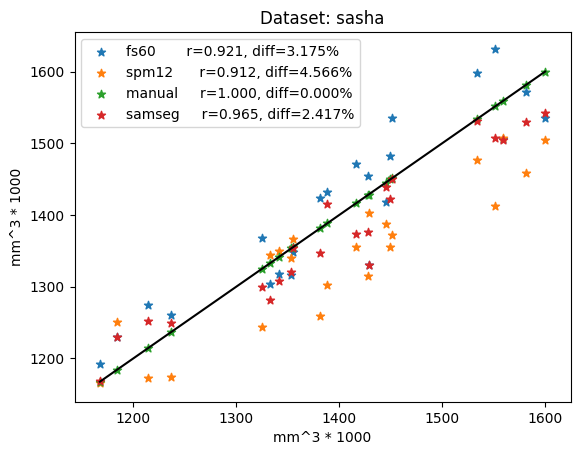
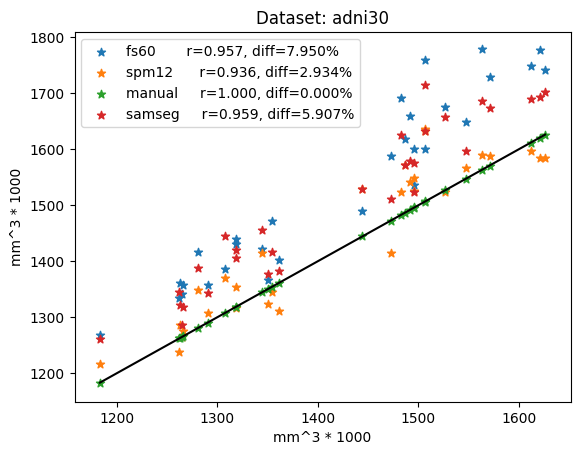
Method performance
As a secondary validation measure, correlations and absolute % difference in measured ICV were computed for a pairwise rotation of freesurfer 6.0, spm 12 and samseg, to explore to what extent the methods 'agree' with each other.
Dataset |
FS 6 vs spm12 |
samseg vs FS |
samseg vs spm12 |
ADNI30 |
r=0.922, diff=6.588% |
r=0.975, diff=2.697% |
r=0.961, diff=4.131% |
Project Notes
Tasks
- NS - confirm Usage format and Validation plan with Contributors
- CL/AH - update the Method section with the sbTIV algorithm/approach
AH - copy SASHA datasets to samseg/subjects dirs from locations shown in eTIV page [DONE]
- AH - run SPM12 eTIV function on SASHA, Buckner40, ADNI60, IXI_79 datasets
CL/AH - create validation scripts, whereby given a set of sbTIV measures for a dataset, plot against the reference dataset (either manual values or eTIV) see Methods section of eTIV for details on SASHA scripts, and the Malone paper for their approach.
- AH - Identify subject names for the 300 ADNI_T2TCV subjects that are grade 3 found in TCV.csv and download source images, preferably in DICOM format.