
|
Size: 4647
Comment:
|
Size: 5677
Comment:
|
| Deletions are marked like this. | Additions are marked like this. |
| Line 1: | Line 1: |
| [wiki:Self:FreeSurferWiki top] | [wiki:Self:Installation previous] | [wiki:Self:SetupConfiguration next] | [[DownloadAndInstall|top]] | [[Installation|previous]] | [[SetupConfiguration|next]] |
| Line 3: | Line 3: |
| == FreeSurfer Mac OS X Installation and Setup == | = FreeSurfer Mac OS X Installation and Setup = This page details how to install !FreeSurfer on a Mac OS X machine, from download to set up. The full installation package provided by MGH includes support libraries and a sample data set. |
| Line 5: | Line 6: |
| This page details how to install FreeSurfer on a Mac OS X machine, from download to set up. The full installation package provided by MGH includes support libraries and a sample data set. | '''Prerequisite:''' The Max OS X machine must have [[http://xquartz.macosforge.org/landing|XQuartz]] installed before you can run !FreeSurfer. To check if you already have [[http://xquartz.macosforge.org/landing|XQuartz]], open a Finder window and it would appear in the Finder under '''Applications -> Utilities -> XQuartz'''. If it does not show up, please download and install [[http://xquartz.macosforge.org/landing|XQuartz]] first. *NOTE:* Major upgrades to you Mac system (e.g. Mountain Lion -> Mavericks) will require a reinstallation of [[http://xquartz.macosforge.org/landing|XQuartz]]. |
| Line 7: | Line 8: |
| Prerequisite: The Max OS X machine must have the X11 package installed before installing FreeSurfer. It will appear in the Finder under '''Applications -> Utilities -> X11'''. | {{attachment:XQuartz_screencapture.png}} |
| Line 9: | Line 10: |
| attachment:install-x.jpg If it is not present it can be downloaded from [ftp://surfer.nmr.mgh.harvard.edu/pub/dist/X11User-Darwin.dmg ftp://surfer.nmr.mgh.harvard.edu/pub/dist/X11User-Darwin.dmg]. To launch a X terminal window, start X11 by double clicking on it in the Finder, and Terminal can be found under Applications. A new terminal can also be opened by pressing Apple-N while X11 is the primary application. The FreeSurfer software is distributed through the NMR ftp site. Look for the latest version at [ftp://surfer.nmr.mgh.harvard.edu/pub/dist/ ftp://surfer.nmr.mgh.harvard.edu/pub/dist/] and save freesurfer-Darwin-tiger-full.dmg to your local machine. It contains the FreeSurfer binaries, support software, and a sample data set, and may take a few minutes to download even on a fast connection. ## attachment:install-2filelisting.jpg |
The !FreeSurfer software is distributed through the [[Download|NMR download site]]. It contains the !FreeSurfer binaries, support software, and a sample data set, and may take a few minutes to download even on a fast connection. |
| Line 19: | Line 14: |
| attachment:install-4mpkg.jpg | {{attachment:install-4mpkg.jpg}} |
| Line 21: | Line 16: |
| Double click on the '''mpkg''' and the installation wizard will launch as a guide through the set up. | Double click on the '''mpkg''' and the installation wizard will launch as a guide through the set up. If you get an error with the following window popup: {{attachment:install_error.png}} Then you need to adjust your security settings to allow applications from 3rd party developers to be installed. To do this go to '''System Preferences -> Security & Privacy -> General'''. Click the lock on the bottom left to make changes and under '''Allow applications downloaded from:''' select '''Anywhere'''. {{attachment:allow_anywhere.png}} |
| Line 29: | Line 30: |
| attachment:install-5intro.jpg | {{attachment:install-5intro.jpg}} |
| Line 33: | Line 34: |
| attachment:install-6readme.jpg | {{attachment:install-6readme.jpg}} Regardless of what the instructions in the '''Read Me''' screen say, the best way so automatically load !FreeSurfer whenever a terminal window is opened is to add the following lines to the '''.profile''' file in your home directory (If you don't already have a '''.profile''' file in your home directory, you can go ahead and create one): {{{ export FREESURFER_HOME=/Applications/freesurfer source $FREESURFER_HOME/SetUpFreeSurfer.sh }}} |
| Line 43: | Line 51: |
| Click on '''Agree''', and the next screen will appear. Select where to install the software. The directory /Users/Shared on the selected disk will be used. | Click on '''Agree''', and the next screen will appear. Select where to install the software. The directory /Applications on the selected disk will be used. If you wish to install to a different directory, click on '''Choose''' and select an alternate installation location. |
| Line 45: | Line 53: |
| ## attachment:install-9selectdestination.jpg | {{attachment:install-9selectdestination.jpg}} |
| Line 51: | Line 59: |
| Click on '''Continue''' to confirm the disk selection. From the next screen, the default is to click on '''Upgrade''' for a simple installation of all packages in the archive: | Click on '''Continue''' to confirm the disk selection. |
| Line 53: | Line 61: |
| attachment:install-11easyinstall.jpg | {{attachment:install-11easyinstall.jpg}} |
| Line 55: | Line 63: |
| To customize the installation, click on '''Customize''' and this screen will appear, allowing selection of packages to install: | ## To customize the installation, click on '''Customize''' and this screen will appear, allowing selection of packages to install: |
| Line 57: | Line 65: |
| attachment:install-12custominstall.jpg | ## attachment:install-12custominstall.jpg |
| Line 59: | Line 67: |
| If not all of the packages are selectable, check in the directory /Library/Receipts for directories matching the package names. The operating system will compare the new installation against any old installations, and will prevent upgrades if the version of the package being installed is older than the one currently installed. Remove the receipt directory to reinstall a new version of the desired software packages and restart the installer by double clicking on the mpkg. | ## If not all of the packages are selectable, check in the directory /Library/Receipts for directories matching the package names. The operating system will compare the ## new installation against any old installations, and will prevent upgrades if the version of the package being installed is older than the one currently installed. Remove ## the receipt directory to reinstall a new version of the desired software packages and restart the installer by double clicking on the mpkg. |
| Line 61: | Line 69: |
| Click on '''Install''' and packages will begin to be installed on the designated hard drive. | Click on '''Install''' and the package will begin to be installed on the designated hard drive. |
| Line 75: | Line 83: |
| attachment:install-19success.jpg | {{attachment:install-19success.jpg}} |
| Line 79: | Line 87: |
| Otherwise, click on '''Close''' to exit the installer and begin setting up the environment. | Otherwise, click on '''Close''' to exit the installer. |
| Line 81: | Line 89: |
| [wiki:Self:SetupConfiguration Setup and configuration of the environment is described next.] | Lastly, if you intend to run recon-all (the processing script which can run for 24 hours) on your mac, we recommend setting your Power Adapter Energy Settings to 'Never' sleep, otherwise recon-all will only run when you are logged-in. This is done under '''System Preferences -> Energy Saver'''. {{attachment:no_sleep.png}} [[SetupConfiguration_Mac|Setup and configuration of the environment is described next.]] |
FreeSurfer Mac OS X Installation and Setup
This page details how to install FreeSurfer on a Mac OS X machine, from download to set up. The full installation package provided by MGH includes support libraries and a sample data set.
Prerequisite: The Max OS X machine must have XQuartz installed before you can run FreeSurfer. To check if you already have XQuartz, open a Finder window and it would appear in the Finder under Applications -> Utilities -> XQuartz. If it does not show up, please download and install XQuartz first. *NOTE:* Major upgrades to you Mac system (e.g. Mountain Lion -> Mavericks) will require a reinstallation of XQuartz.
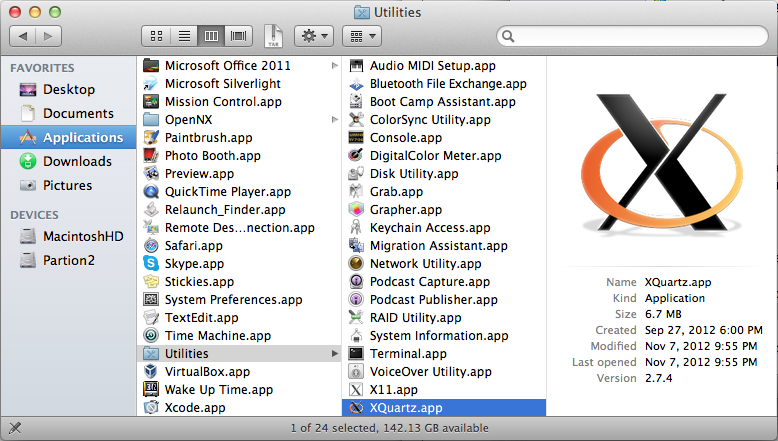
The FreeSurfer software is distributed through the NMR download site. It contains the FreeSurfer binaries, support software, and a sample data set, and may take a few minutes to download even on a fast connection.
Once the dmg has been downloaded, double click on it in the Finder to expand the package, which will result in the following:
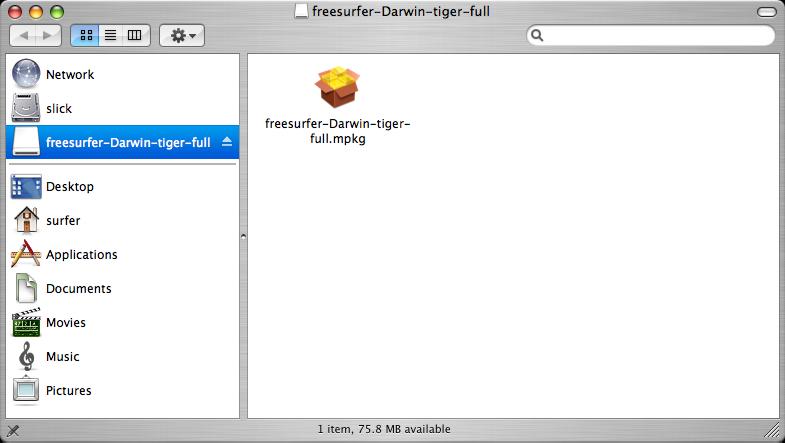
Double click on the mpkg and the installation wizard will launch as a guide through the set up. If you get an error with the following window popup:
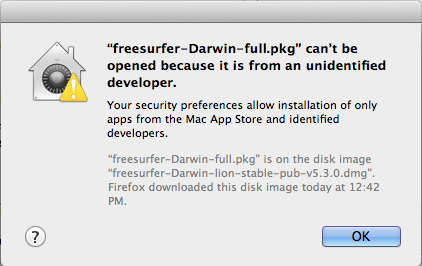
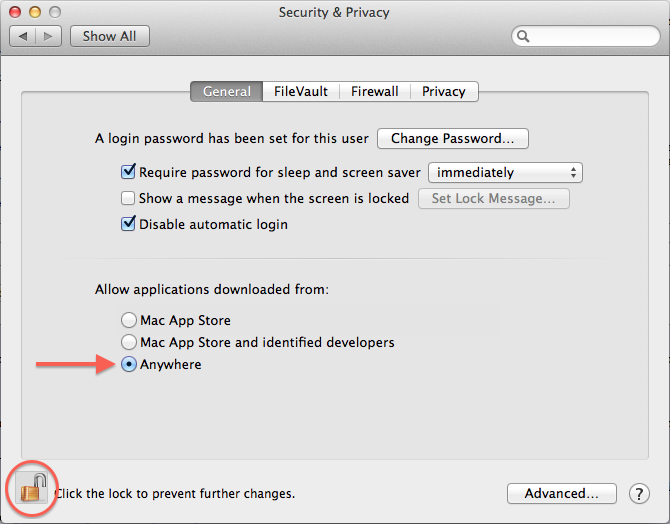
Then you need to adjust your security settings to allow applications from 3rd party developers to be installed. To do this go to System Preferences -> Security & Privacy -> General. Click the lock on the bottom left to make changes and under Allow applications downloaded from: select Anywhere.
After the package integrity has been verified, the introductory screen will appear.
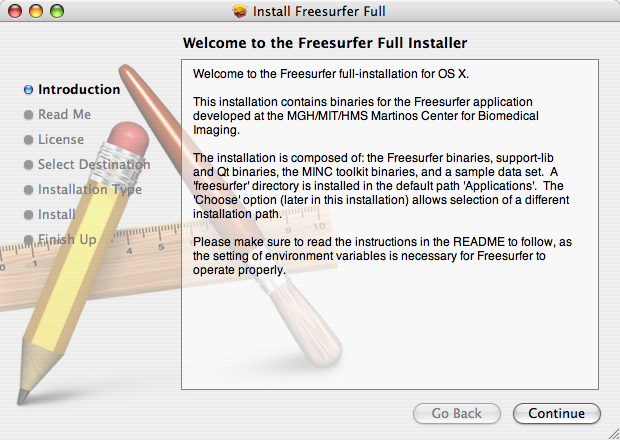
Click on Continue, and read the explanatory text on the Read Me screen, as it contains information useful during the next stage of the installation:
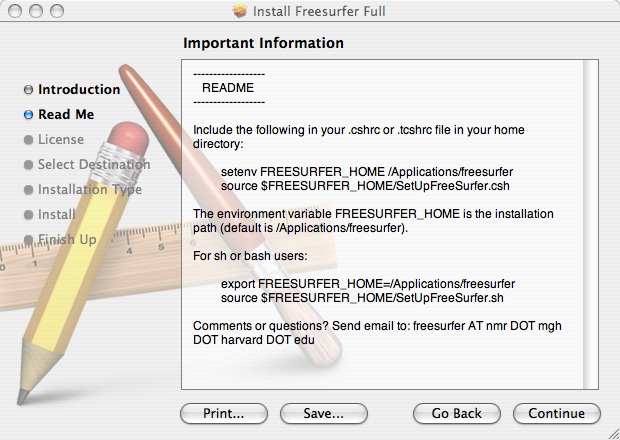
Regardless of what the instructions in the Read Me screen say, the best way so automatically load FreeSurfer whenever a terminal window is opened is to add the following lines to the .profile file in your home directory (If you don't already have a .profile file in your home directory, you can go ahead and create one):
export FREESURFER_HOME=/Applications/freesurfer
source $FREESURFER_HOME/SetUpFreeSurfer.sh
Click on Continue, and read the end user license agreement, scrolling down using the bar along the right side of the window.
Click on Continue and a window will appear with the option to agree or disagree to the license.
Click on Agree, and the next screen will appear. Select where to install the software. The directory /Applications on the selected disk will be used. If you wish to install to a different directory, click on Choose and select an alternate installation location.
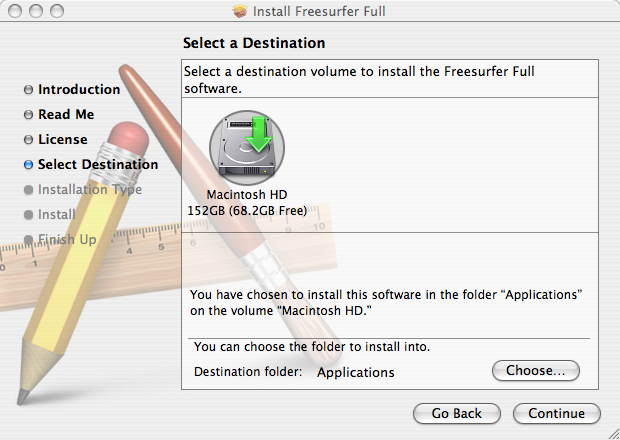
Click on the hard drive on which to install the software; that icon will highlight (if it has not been already selected, which may occur if only one disk is installed).
Click on Continue to confirm the disk selection.
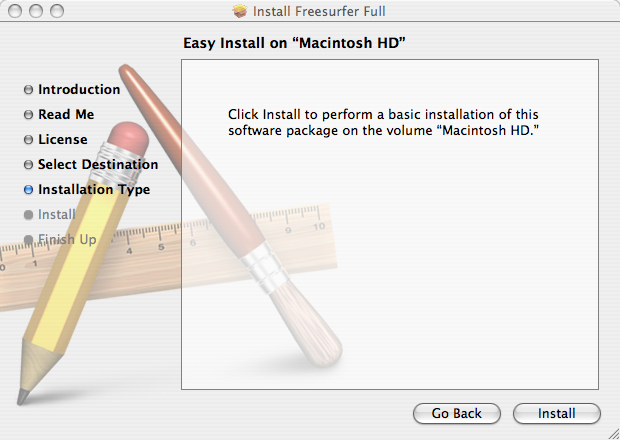
Click on Install and the package will begin to be installed on the designated hard drive.
The installer may then optimize the hard drive for performance.
Once the optimization is finished, the installation process is successfully concluded:
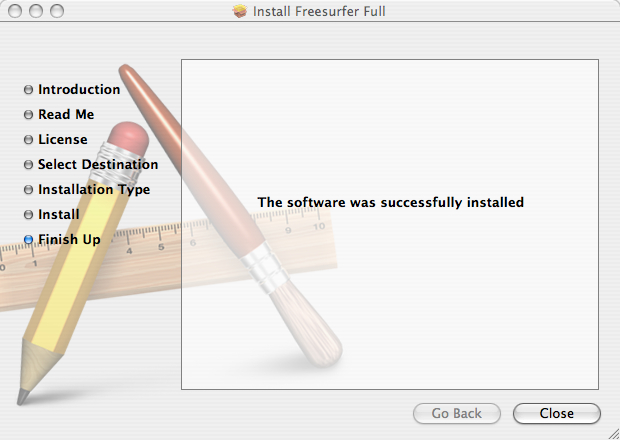
If you encounter errors during the installation, while still in the Installer, and Installer is still the primary application, click the Window -> Installer Log menu item to show the error log to see why installation failed.
Otherwise, click on Close to exit the installer.
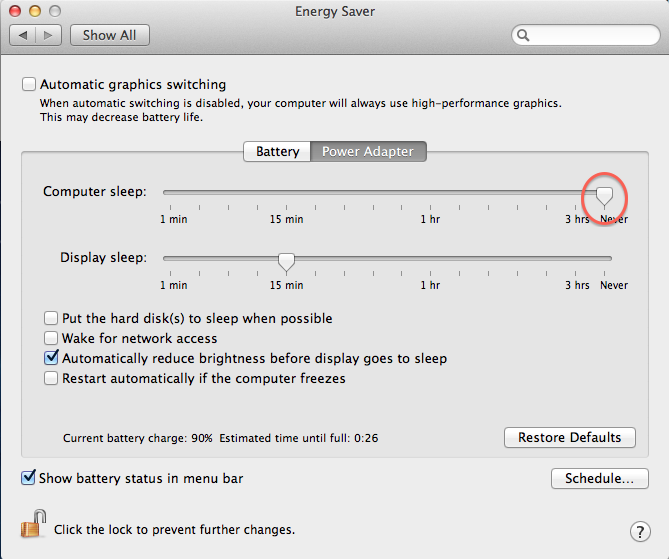
Lastly, if you intend to run recon-all (the processing script which can run for 24 hours) on your mac, we recommend setting your Power Adapter Energy Settings to 'Never' sleep, otherwise recon-all will only run when you are logged-in. This is done under System Preferences -> Energy Saver.
Setup and configuration of the environment is described next.