
|
Size: 9742
Comment:
|
Size: 4058
Comment:
|
| Deletions are marked like this. | Additions are marked like this. |
| Line 1: | Line 1: |
| [wiki:Self:FreeSurferWiki top] | [wiki:Self:Installation previous] | [[DownloadAndInstall|top]] | [[Installation|previous]] | [[SetupConfiguration|next]] |
| Line 3: | Line 3: |
| == FreeSurfer Mac OS X Installation and Setup == | '''Index''' <<TableOfContents>> |
| Line 5: | Line 5: |
| This page details how to install FreeSurfer on a Mac OS X machine, from download to set up. The full installation package provided by MGH includes support libraries and a sample data set. | = Installation = '''Before proceeding:''' Mac OSX requires the installation of XQuartz for freesurfer to function properly. OSX versions 10.6, 10.7, 10.8, and 10.9 require [[http://xquartz.macosforge.org/downloads/SL/XQuartz-2.7.5.dmg|XQuartz 2.7.5]] (or earlier). OSX versions 10.10 and later require [[http://xquartz.macosforge.org/downloads/SL/XQuartz-2.7.6.dmg|XQuartz 2.7.6]] (or higher). Check '''Application -> Utilities''' to see if XQuartz is already installed. If not use the links to download and then install the proper version. You may need to logout and log back in after XQuartz is installed. |
| Line 7: | Line 8: |
| === 1.0 Downloading software === | {{attachment:XQuartz_screencapture.png}} |
| Line 9: | Line 10: |
| Prerequisite: The Max OS X machine must have the X11 package installed before installing FreeSurfer. It will appear in the Finder under '''Applications -> Utilities -> X11'''. | Download the freesurfer '''dmg''' installation package and double click on it to expand the package: |
| Line 11: | Line 12: |
| attachment:install-x.jpg | {{attachment:install-5mpkg.png}} |
| Line 13: | Line 14: |
| If it is not present it can be downloaded from [ftp://surfer.nmr.mgh.harvard.edu/pub/dist/X11User-Darwin.dmg ftp://surfer.nmr.mgh.harvard.edu/pub/dist/X11User-Darwin.dmg]. To launch a X terminal window, start X11 by double clicking on it in the Finder, and Terminal can be found under Applications. A new terminal can also be opened by pressing Apple-N while X11 is the primary application. | Double click on '''freesurfer-Darwin-full.pkg''' to launch the installation wizard. If you get this error: |
| Line 15: | Line 16: |
| The FreeSurfer software is distributed through the NMR ftp site. Look for the latest version at [ftp://surfer.nmr.mgh.harvard.edu/pub/dist/ ftp://surfer.nmr.mgh.harvard.edu/pub/dist/] and save freesurfer-Darwin-tiger-full.dmg to your local machine. It contains the FreeSurfer binaries, support software, and a sample data set, and may take a few minutes to download even on a fast connection. | {{attachment:install_error.png}} |
| Line 17: | Line 18: |
| ## attachment:install-2filelisting.jpg | Then you need to adjust your security settings to allow applications from 3rd party developers to be installed. To do this go to '''System Preferences -> Security & Privacy -> General'''. Click the lock on the bottom left to make changes and under '''Allow applications downloaded from:''' select '''Anywhere'''. |
| Line 19: | Line 20: |
| === 2.0 Installing software === Once the '''dmg''' has been downloaded, double click on it in the Finder to expand the package, which will result in the following: attachment:install-4mpkg.jpg Double click on the '''mpkg''' and the installation wizard will launch as a guide through the set up. |
{{attachment:allow_anywhere.png}} |
| Line 27: | Line 23: |
| Line 30: | Line 25: |
| After the package integrity has been verified, the introductory screen will appear. | After the package integrity has been verified, the introductory screen will appear. Click on '''Continue''': |
| Line 32: | Line 27: |
| attachment:install-5intro.jpg | {{attachment:install-5intro.jpg}} |
| Line 34: | Line 29: |
| Click on '''Continue''', and read the explanatory text on the '''Read Me''' screen, as it contains information useful during the next stage of the installation: | Next is the Read Me window. Click on '''Continue''': |
| Line 36: | Line 31: |
| attachment:install-6readme.jpg | {{attachment:readme1.png}} |
| Line 38: | Line 33: |
| Click on '''Continue''', and read the end user license agreement, scrolling down using the bar along the right side of the window. | Next is the Software License Agreement window. Click on '''Continue''': |
| Line 40: | Line 35: |
| ## attachment:install-7license.jpg | {{attachment:SLA.png}} |
| Line 42: | Line 37: |
| Click on '''Continue''' and a window will appear with the option to agree or disagree to the license. | Next is the Destination Select window. Click '''Change Install Location...''' to change the default installation disk and folder (/Applications/freesurfer). Or click '''Install''' to go with default: |
| Line 44: | Line 39: |
| ## attachment:install-8licenseclick.jpg | {{attachment:install_location.png}} |
| Line 46: | Line 41: |
| Click on '''Agree''', and the next screen will appear. Select where to install the software. The directory /Users/Shared on the selected disk will be used. | You may need to enter you password. The installation process will begin to write files and will take a few minutes to complete. |
| Line 48: | Line 43: |
| ## attachment:install-9selectdestination.jpg | {{attachment:successful.png}} |
| Line 50: | Line 45: |
| Click on the hard drive on which to install the software; that icon will highlight (if it has not been already selected, which may occur if only one disk is installed). | ----- |
| Line 52: | Line 47: |
| ## attachment:install-10destinationselected.jpg | = Setup and Configuration = |
| Line 54: | Line 49: |
| Click on '''Continue''' to confirm the disk selection. From the next screen, the default is to click on '''Upgrade''' for a simple installation of all packages in the archive: | To begin using freesurfer, open a terminal window. The Terminal application is found under '''Applications -> Utilities -> Terminal''': |
| Line 56: | Line 51: |
| attachment:install-11easyinstall.jpg | {{attachment:terminal.png}} |
| Line 58: | Line 53: |
| To customize the installation, click on '''Customize''' and this screen will appear, allowing selection of packages to install: | Type the following lines in the terminal window to source the freesurfer environment: |
| Line 60: | Line 55: |
| attachment:install-12custominstall.jpg If not all of the packages are selectable, check in the directory /Library/Receipts for directories matching the package names. The operating system will compare the new installation against any old installations, and will prevent upgrades if the version of the package being installed is older than the one currently installed. Remove the receipt directory to reinstall a new version of the desired software packages and restart the installer by double clicking on the mpkg. Click on '''Install''' and packages will begin to be installed on the designated hard drive. ## attachment:install-13procfsbins.jpg ## attachment:install-14procfssupport.jpg ## attachment:install-15procdata.jpg ## attachment:install-16procminc.jpg ## attachment:install-17procfullinst.jpg The installer may then optimize the hard drive for performance. ## attachment:install-18optimisinghd.jpg Once the optimization is finished, the installation process is successfully concluded: attachment:install-19success.jpg If you encounter errors during the installation, while still in the Installer, and Installer is still the primary application, click the '''Window -> Installer Log''' menu item to show the error log to see why installation failed. A possible error is the failure to write to the /Library/Receipts directory. This can occur if installing without Admin privileges, and the error can be safely ignored, as the Freesurfer package was installed to the /Users/Shared directory, which does not require Admin privileges to write files. Freesurfer will operate properly. Otherwise, click on '''Close''' to exit the installer and begin setting up the environment. === 3.0 Setting up environment === The read-me screen of the installer provides directions on setting up the environment to allow running FreeSurfer, and this is reviewed next. ## attachment:install-6readme.jpg Usage of C shell (csh) or enhanced C shell (tcsh) is recommended. The shell type on your system can be checked by typing '''ps''' at the command line in an X terminal window. If csh or tcsh does not appear as one of the processes in the right hand column of output, the default shell must be changed to csh or tcsh. Otherwise, explicitly launch csh or tcsh before attempting to go further. To explicitly launch csh or tcsh (tcsh is recommended), simply enter the following command in an X terminal window: |
|
| Line 92: | Line 56: |
| tcsh }}} The prompt may change, and some login files may not be run in the new shell environment. See the man pages for tcsh for details. If you do not have a preference for a particular shell, the default shell under Mac OS X can be permanently switched from bash to tcsh by typing the following: {{{ chsh -s /bin/tcsh |
export FREESURFER_HOME=/Application/freesurfer source $FREESURFER_HOME/SetUpFreeSurfer.sh |
| Line 101: | Line 60: |
| The file freesurfer/SetUpFreeSurfer.csh is a csh (C-shell) script that will configure the environment so that FreeSurfer can be used. It sets a few environment variables, sources other csh scripts to set up support libraries, and performs some checks that need to be passed before FreeSurfer can start. This file needs to be sourced before running any FreeSurfer binaries. | After you source freesurfer you should see some output similar to the window below: |
| Line 103: | Line 62: |
| This can be done manually via typing the following command in an X terminal window: {{{ source /Users/Shared/freesurfer/SetUpFreeSurfer.csh }}} Alternately, the resource file for the shell can be configured to source the file automatically each time the shell is started. In the home directory of the user who will be running FreeSurfer binaries, edit the file '''.cshrc''' if C-shell will be used, or '''.tcshrc''' for enhanced C-shell, to include the line: {{{ source /Users/Shared/freesurfer/SetUpFreeSurfer.csh }}} |
{{attachment:source_freesurfer.png}} |
| Line 112: | Line 64: |
| A sample subject directory is provided with the full installation, in /Users/Shared/freesurfer/subjects. If custom subject directories are created using mksubjectdirs or a different sample data set is used, let FreeSurfer know where to look by inserting the following line before the source command above: {{{ setenv SUBJECTS_DIR [path to subject directory] }}} |
If you use freesurfer frequently and want to avoid typing the above lines of code every time you open a terminal window, you can create a file called '''.profile''' in your home directory which contains those two line. This will cause the terminal window to automatically source freesurfer every time it is opened. |
| Line 117: | Line 66: |
| Make sure to use C shell (csh) or enhanced C shell (tcsh). This can be checked by typing '''ps''' at the command line in an X terminal window. If csh or tcsh does not appear as one of the processes in the right hand column of output, the default shell must be changed to csh or tcsh. Otherwise, explicitly launch csh or tcsh before attempting to go further. To explicitly launch csh or tcsh (tcsh is recommended), simply enter the following command in an X terminal window: {{{ tcsh }}} The prompt may change, and some login files may not be run in the new shell environment. See the man pages for tcsh for details. |
At this point you are ready to begin using the freesurfer software. If you haven't done so already, [[Registration|obtain a license]], and copy the license.txt file into your $FREESURFER_HOME (Applications/freesurfer) directory. |
| Line 123: | Line 68: |
| As the shell starts up, messages are printed out showing the environment variables that have been set by the configuration scripts. The following example shows a case where the SUBJECTS_DIR has been set to something other than the default: {{{ Setting up environment for FreeSurfer/FS-FAST FREESURFER_HOME /Users/Shared/freesurfer FSFAST_HOME /Users/Shared/freesurfer/fsfast SUBJECTS_DIR /Users/Shared/freesurfer/subjects FUNCTIONALS_DIR /Users/Shared/freesurfer/sessions MINC_BIN_DIR /Users/Shared/freesurfer/lib/mni/bin MINC_LIB_DIR /Users/Shared/freesurfer/lib/mni/lib QTDIR /Users/Shared/freesurfer/lib/qt LIBS_DIR /Users/Shared/freesurfer/lib/misc }}} |
----- |
| Line 136: | Line 70: |
| If any warnings appear, it's usually safe to ignore them, but make sure that they are not stating that a file or directory that should exist cannot be found. | = Testing Freesurfer = |
| Line 138: | Line 72: |
| If any error messages appear, check that the installation process was successfully completed. | See the following page for some example commands to test that freesurfer is installed and running properly. https://surfer.nmr.mgh.harvard.edu/fswiki/TestingFreeSurfer |
| Line 140: | Line 75: |
| === 4.0 Practice data === | ## Lastly, if you intend to run recon-all (the processing script which can run for 24 hours) on your mac, we recommend setting your Power Adapter Energy Settings to 'Never' sleep, otherwise recon-all will only run when you are logged-in. This is done under '''System Preferences -> Energy Saver'''. |
| Line 142: | Line 77: |
| A public distribution data set is available to run the tutorials. It contains 40 subjects, and occupies about 21G of disk-space. The file is available from the [ftp://surfer.nmr.mgh.harvard.edu/pub/dist distribution site], and is called [ftp://surfer.nmr.mgh.harvard.edu/pub/dist/buckner_public_distribution.tar.gz buckner_public_distribution.tar.gz]. | ## {{attachment:no_sleep.png}} |
| Line 144: | Line 79: |
| Once the file is downloaded, move the file to the $FREESURFER_HOME/subjects directory, and uncompress and install with the following command: {{{ tar zxvf buckner_public_distribution.tar.gz }}} The downloaded file can then be deleted. To setup the environment variables SUBJECTS_DIR and SUBJECTS to point to this data, type the following command or include in your .cshrc or .tcshrc file: {{{ source $FREESURFER_HOME/subjects/buckner_public_distribution/sample_group_study/scripts/subjects.csh }}} |
## If you came from the Quick Install page, return to that [[QuickInstall|here]].<<BR>> ## Otherwise, setup and configuration of the environment is described [[SetupConfiguration_Mac|next.]] |
Index
Installation
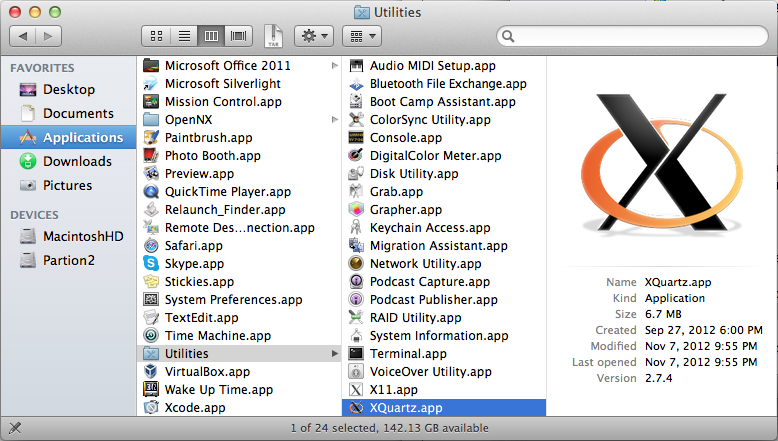
Before proceeding: Mac OSX requires the installation of XQuartz for freesurfer to function properly. OSX versions 10.6, 10.7, 10.8, and 10.9 require XQuartz 2.7.5 (or earlier). OSX versions 10.10 and later require XQuartz 2.7.6 (or higher). Check Application -> Utilities to see if XQuartz is already installed. If not use the links to download and then install the proper version. You may need to logout and log back in after XQuartz is installed.
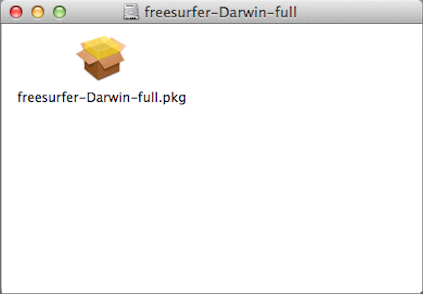
Download the freesurfer dmg installation package and double click on it to expand the package:
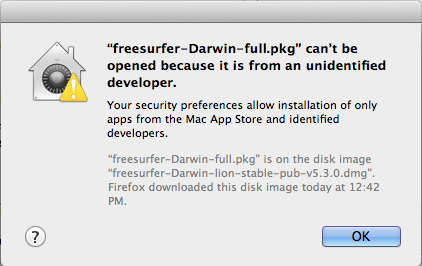
Double click on freesurfer-Darwin-full.pkg to launch the installation wizard. If you get this error:
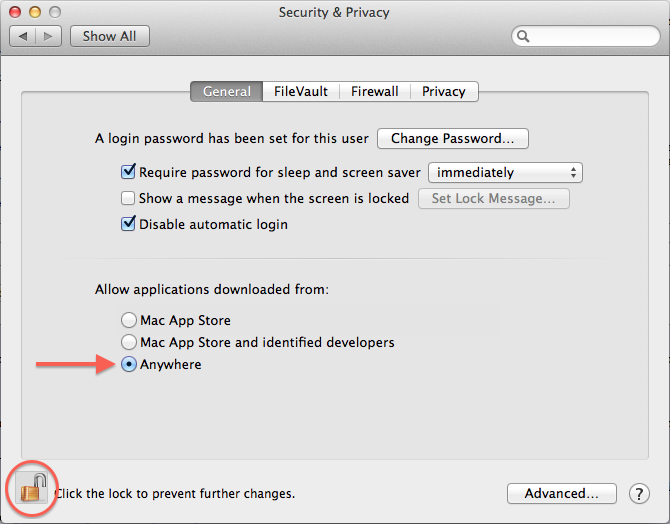
Then you need to adjust your security settings to allow applications from 3rd party developers to be installed. To do this go to System Preferences -> Security & Privacy -> General. Click the lock on the bottom left to make changes and under Allow applications downloaded from: select Anywhere.
After the package integrity has been verified, the introductory screen will appear. Click on Continue:
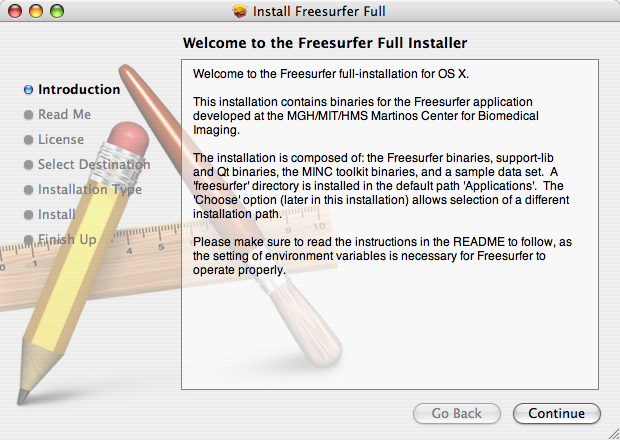
Next is the Read Me window. Click on Continue:
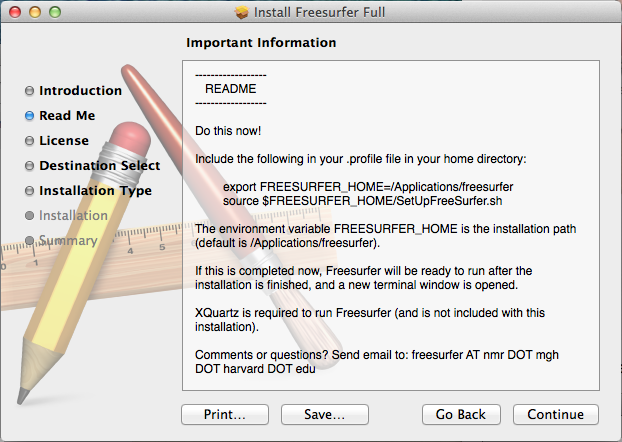
Next is the Software License Agreement window. Click on Continue:
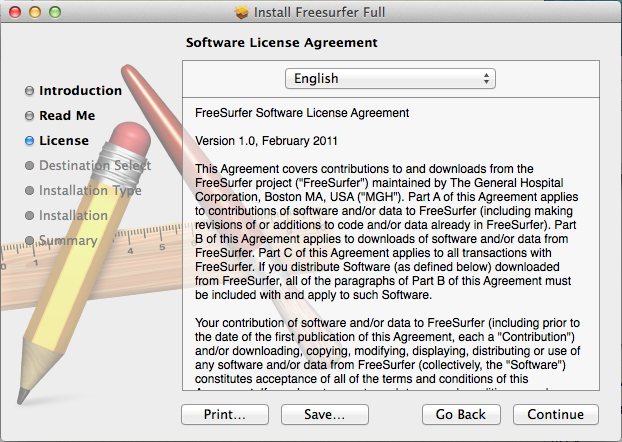
Next is the Destination Select window. Click Change Install Location... to change the default installation disk and folder (/Applications/freesurfer). Or click Install to go with default:
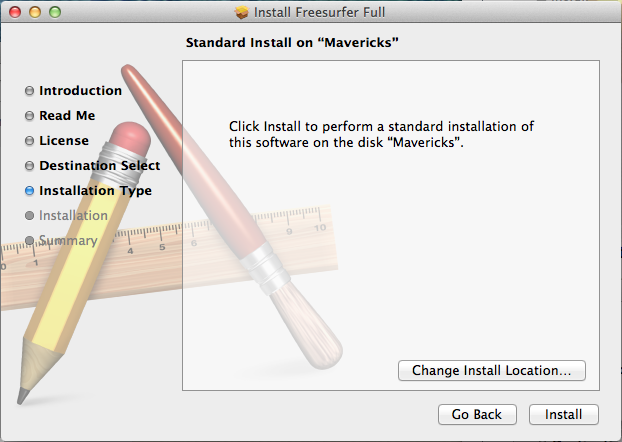
You may need to enter you password. The installation process will begin to write files and will take a few minutes to complete.
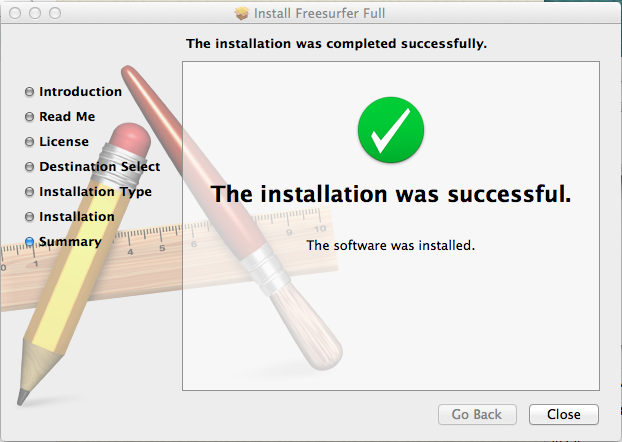
Setup and Configuration
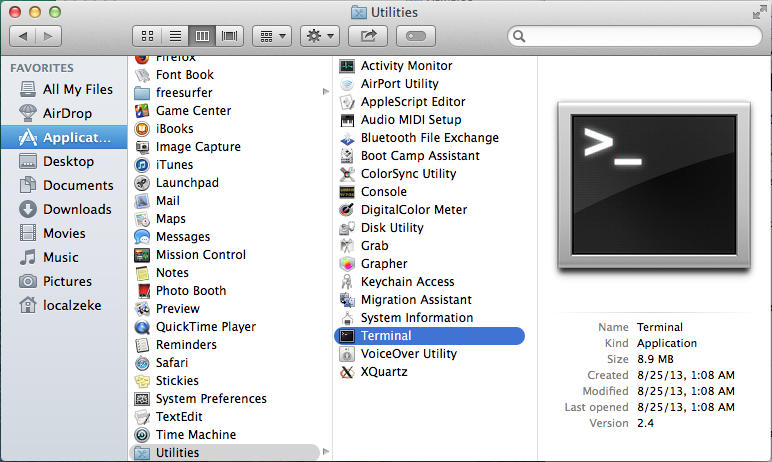
To begin using freesurfer, open a terminal window. The Terminal application is found under Applications -> Utilities -> Terminal:
Type the following lines in the terminal window to source the freesurfer environment:
export FREESURFER_HOME=/Application/freesurfer source $FREESURFER_HOME/SetUpFreeSurfer.sh
After you source freesurfer you should see some output similar to the window below:
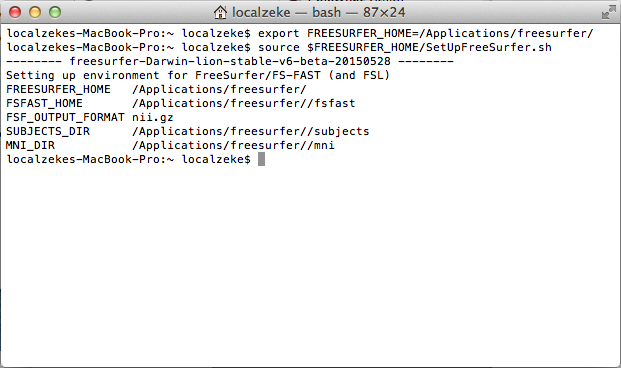
If you use freesurfer frequently and want to avoid typing the above lines of code every time you open a terminal window, you can create a file called .profile in your home directory which contains those two line. This will cause the terminal window to automatically source freesurfer every time it is opened.
At this point you are ready to begin using the freesurfer software. If you haven't done so already, obtain a license, and copy the license.txt file into your $FREESURFER_HOME (Applications/freesurfer) directory.
Testing Freesurfer
See the following page for some example commands to test that freesurfer is installed and running properly. https://surfer.nmr.mgh.harvard.edu/fswiki/TestingFreeSurfer