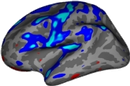
|
Size: 2625
Comment:
|
Size: 1759
Comment:
|
| Deletions are marked like this. | Additions are marked like this. |
| Line 1: | Line 1: |
| Two Groups (One Factor/Two Levels), One Covariates | [[FsgdExamples|Back to FSGD Examples]] |
| Line 3: | Line 3: |
| This models the input as two lines. If DODS, then each line has its own intercept and slope. If DOSS, then each line has its own intercept but they share a slope. |
~+'''One Group, One Covariate'''+~ |
| Line 7: | Line 5: |
| FSGD File: example3.fsgd | This models the input as a single line (ie, an intercept and a slope). factor (eg, Age). Because there is only one group, this will be the same for both DODS and DOSS. <<TableOfContents>> = FSGD File (g1v1.fsgd) = |
| Line 11: | Line 15: |
| Class Group1 Class Group2 Variable Age Input subject1 Group1 30 Input subject2 Group2 40 |
Class Main Variables Age Input subject1 Main 30 Input subject2 Main 40 |
| Line 18: | Line 21: |
| Nclasses = 2<<BR>> Nvariables = 1<<BR>> |
Nclasses = 1 <<BR>> Nvariables = 1 <<BR>> |
| Line 21: | Line 24: |
| -------------------------------------------------------------------------------------- DODS Regressors: <<BR>> Nregressors = Nclasses*(Nvariables+1) = 2*(1+1) = 4 <<BR>> Regressor1: ones for subjects in Group 1, 0 otherwise. Codes intercept/mean for Group 1 <<BR>> Regressor2: ones for subjects in Group 2, 0 otherwise. Codes intercept/mean for Group 2 <<BR>> Regressor3: age for subjects in Group 1, 0 otherwise. Codes age slope for Group 1 <<BR>> Regressor4: age for subjects in Group 2, 0 otherwise. Codes age slope for Group 2 <<BR>> |
= Regressors = |
| Line 30: | Line 26: |
| Contrasts: | NregressorsDODS = Nclasses*(Nvariables+1) = 1*(1+1) = 2 <<BR>> NregressorsDOSS = Nclassesd + Nvariables = 1+1 = 2 <<BR>> Regressor1: All ones. Codes intercept/mean for Main <<BR>> Regressor2: age for each subject. Codes age slope for Group 1 <<BR>> |
| Line 32: | Line 31: |
| Contrast1: ------------ Null Hypothesis: is there a difference between the group intercepts? |
= Contrasts = |
| Line 35: | Line 33: |
| Contrast File: g1-g2.intercept.mtx --------------- cut here -------------- 1 -1 0 0 --------------- cut here -------------- |
The number of columns in each contrast matrix must be the same as the number of regressors (Nregressors). If there is only one row in the contrast matrix, then the result will be a t-test and will have a sign. Reversing the signs in the contrast matrix will only change the sign of the output, not its magnitude. If there is more than one row, the result will be an F-test and will be unsigned. |
| Line 40: | Line 40: |
| Since this is a t-test, the output will be signed, with Group1>Group2 being positive (red/yellow). Reversing the sign will only change the sign of the output, not its magnitude. |
== Contrast 1 (intercept.mtx) == Null Hypothesis: is the intercept equal to 0? |
| Line 44: | Line 43: |
| Contrast2: ------------ | {{{ 1 0 }}} |
| Line 46: | Line 47: |
| Null Hypothesis: is there a difference between the group slopes? Note: this is an interaction between group and age. Note: not possible to test with DOSS |
This is a t-test with the intercept>0 being positive (red/yellow). |
| Line 50: | Line 49: |
| Contrast File: g1-g2.slope.mtx --------------- cut here -------------- 0 0 1 -1 --------------- cut here -------------- |
== Contrast 2 (slope.mtx) == |
| Line 55: | Line 51: |
| Since this is a t-test, the output will be signed, with Group1>Group2 being positive (red/yellow). Reversing the sign will only change the sign of the output, not its magnitude. |
Null Hypothesis: is the slope equal to 0? |
| Line 59: | Line 53: |
| Contrast3: ------------ Null Hypothesis: does Group1 differ from Group2 in intercept or slope? |
{{{ 0 1 }}} |
| Line 62: | Line 57: |
| Contrast File: g1-vs-g2.mtx --------------- cut here -------------- 1 -1 0 0 0 0 1 -1 --------------- cut here -------------- Note: this is an F-test (and hence unsigned). |
This is a t-test with the slope>0 being positive (red/yellow). |
| Line 69: | Line 59: |
| Contrast4: ------------ Null Hypothesis: does mean of group intercepts differ from 0? |
= mri_glmfit command = |
| Line 72: | Line 61: |
| Contrast File: g1g2.intercept.mtx --------------- cut here -------------- 0.5 0.5 0 0 --------------- cut here -------------- |
This is an example invocation of mri_glmfit. Depending upon your application, you may have other options as well. |
| Line 77: | Line 64: |
| Contrast5: ------------ Null Hypothesis: does mean of group slopes differ from 0? Contrast File: g1g2.intercept.mtx --------------- cut here -------------- 0 0 0.5 0.5 --------------- cut here -------------- |
{{{ mri_glmfit \ --glmdir g1v1 \ --y y.mgh \ --fsgd g1v1.fsgd \ --C intercept.mtx \ --C slope.mtx }}} |
One Group, One Covariate
This models the input as a single line (ie, an intercept and a slope). factor (eg, Age). Because there is only one group, this will be the same for both DODS and DOSS.
Contents
FSGD File (g1v1.fsgd)
GroupDescriptorFile 1
Title OSGM
Class Main
Variables Age
Input subject1 Main 30
Input subject2 Main 40
Nclasses = 1
Nvariables = 1
Regressors
NregressorsDODS = Nclasses*(Nvariables+1) = 1*(1+1) = 2
NregressorsDOSS = Nclassesd + Nvariables = 1+1 = 2
Regressor1: All ones. Codes intercept/mean for Main
Regressor2: age for each subject. Codes age slope for Group 1
Contrasts
The number of columns in each contrast matrix must be the same as the number of regressors (Nregressors). If there is only one row in the contrast matrix, then the result will be a t-test and will have a sign. Reversing the signs in the contrast matrix will only change the sign of the output, not its magnitude. If there is more than one row, the result will be an F-test and will be unsigned.
Contrast 1 (intercept.mtx)
Null Hypothesis: is the intercept equal to 0?
1 0
This is a t-test with the intercept>0 being positive (red/yellow).
Contrast 2 (slope.mtx)
Null Hypothesis: is the slope equal to 0?
0 1
This is a t-test with the slope>0 being positive (red/yellow).
mri_glmfit command
This is an example invocation of mri_glmfit. Depending upon your application, you may have other options as well.
mri_glmfit \
  --glmdir g1v1 \
  --y y.mgh \
  --fsgd g1v1.fsgd \
  --C intercept.mtx \
  --C slope.mtx