|
Size: 7650
Comment:
|
Size: 7918
Comment:
|
| Deletions are marked like this. | Additions are marked like this. |
| Line 62: | Line 62: |
| tksurfer subject2_before lh inflated & tksurfer subject2_before rh inflated & |
tksurfer wm1_edits_before lh inflated & tksurfer wm1_edits_before rh inflated & |
| Line 68: | Line 68: |
| You may need to open other volumes in order to see or fix the problem. Take a look through this subject and see if you can identify what is wrong. | The trouble with this subject has occurred during the white matter segmentation step. Check the surfaces to find the spot that does not match the actual boundaries. If you load the wm.mgz volume as the aux volume you will see a hole in this area. If you are looking in tksurfer you will see a hole or dimple in the inflated surface. You can use the "save point" "goto point" commands to find this spot in the volume. You may need to open other volumes in order to see or fix the problem. |
| Line 70: | Line 71: |
| If you are stuck and you need a [[FsTutorial/TroubleshootingHints|hint]] you can click for some help. When you think you've identified the problem, click [[FsTutorial/WhiteMatterEdits|here]] for detailed instructions on how you can fix it. You can also compare this to the finished version, subject2_after |
Click [[FsTutorial/WhiteMatterEdits|here]] for detailed instructions on how you can fix it. You can also compare this to the finished version, wm1_edits_after. |
| Line 75: | Line 74: |
| Now, take a look at the next subject, subject3_before. | Now, take a look at the next subject, pial_edits_before. |
| Line 78: | Line 77: |
| tkmedit subject3_before brainmask.mgz \ | tkmedit pial_edits_before brainmask.mgz \ |
| Line 88: | Line 87: |
| tksurfer subject3_before lh inflated & tksurfer subject3_before rh inflated & |
tksurfer pial_edits_before lh inflated & tksurfer pial_edits_before rh inflated & |
| Line 94: | Line 93: |
| You may need to open other volumes in order to see or fix the problem. Take a look through this subject and see if you can identify what is wrong. | The trouble with this subject has occurred while making the final surfaces. Check the final surfaces (pial and white surfaces) to make sure that they follow the actual boundaries and that they do not include anything that should not be included. |
| Line 96: | Line 95: |
| If you are stuck and you need a [[FsTutorial/TroubleshootingHints|hint]] you can click for some help. | You may need to open other volumes in order to see or fix the problem. |
| Line 98: | Line 97: |
| When you think you've identified the problem, click [[FsTutorial/PialEdits|here]] for detailed instructions on how you can fix it. | Click [[FsTutorial/PialEdits|here]] for detailed instructions on how you can fix it. |
| Line 101: | Line 100: |
| Now you can open the first subject, subject1_before, in tkmedit. | Now, take a look at the next subject, skullstrip1_before, in tkmedit. |
| Line 104: | Line 103: |
| tkmedit subject1_before brainmask.mgz \ | tkmedit skullstrip1_before brainmask.mgz \ |
| Line 111: | Line 110: |
| You can feel free to open other volumes in aux or to load in the aseg.mgz if you want or need to. Take a look at this first subject, inspecting the various outputs that were mentioned in the [[FsTutorial/OutputData|previous exercise]] and see if you can indentify what is wrong. | The trouble with this subject has occurred in the skull stripping step. Check the brainmask.mgz volume carefully, comparing it to the T1.mgz volume (loaded in aux) to make sure that the skull has been completely stripped away, leaving behind the complete cortex and the cerebellum. |
| Line 113: | Line 112: |
| If you are stuck and you need a [[FsTutorial/TroubleshootingHints|hint]] you can click for some help. | You can feel free to open other volumes in aux or to load in the aseg.mgz if you want or need to. |
| Line 115: | Line 114: |
| When you think you've identified the problem, click [[FsTutorial/SkullStripFix|here]] for detailed instructions on how you can fix it. You can also compare this to the finished version, subject1_after. | Click [[FsTutorial/SkullStripFix|here]] for detailed instructions on how you can fix it. You can also compare this to the finished version, skullstrip1_after. |
| Line 118: | Line 117: |
| Now, take a look at the next subject, subject4_before. | Now, take a look at the next subject, cp_before. |
| Line 121: | Line 120: |
| tkmedit subject4_before brainmask.mgz \ | tkmedit cp_before brainmask.mgz \ |
| Line 131: | Line 130: |
| tksurfer subject4_before lh inflated & tksurfer subject4_before rh inflated & |
tksurfer cp_before lh inflated & tksurfer cp_before rh inflated & |
| Line 137: | Line 136: |
| You may need to open other volumes in order to see or fix the problem. Take a look through this subject and see if you can identify what is wrong. | The trouble with this subject has occured during the intensity normalization. Check the white surface and be sure it is including all of the white matter as it should. If you find an area that is not included as white matter be sure to check to see that the intensity is at (or very close to) 110. |
| Line 139: | Line 138: |
| If you are stuck and you need a [[FsTutorial/TroubleshootingHints|hint]] you can click for some help. | You may need to open other volumes in order to see or fix the problem. |
| Line 141: | Line 140: |
| When you think you've identified the problem, click [[FsTutorial/ControlPoints|here]] for detailed instructions on how you can fix it. | Click [[FsTutorial/ControlPoints|here]] for detailed instructions on how you can fix it. |
| Line 144: | Line 143: |
| Now, take a look at the next subject, subject5_before. | Now, take a look at the next subject, tal_before. |
| Line 147: | Line 146: |
| tkmedit subject5_before brainmask.mgz \ | tkmedit tal_before brainmask.mgz \ |
| Line 157: | Line 156: |
| tksurfer subject5_before lh inflated & tksurfer subject5_before rh inflated & |
tksurfer tal_before lh inflated & tksurfer tal_before rh inflated & |
| Line 163: | Line 162: |
| You may need to open other volumes in order to see or fix the problem. Take a look through this subject and see if you can identify what is wrong. | The trouble with this subject is a little tricky to figure out. The midline cutting planes are not actually on the midline, but the real root of this problem is in one of the very initial steps of recon-all. The talairach transform is bad and will need to be fixed. |
| Line 165: | Line 164: |
| If you are stuck and you need a [[FsTutorial/TroubleshootingHints|hint]] you can click for some help. | You may need to open other volumes in order to see or fix the problem. |
| Line 167: | Line 166: |
| When you think you've identified the problem, click [[FsTutorial/Talairach|here]] for detailed instructions on how you can fix it. | Click [[FsTutorial/Talairach|here]] for detailed instructions on how you can fix it. |
Troubleshooting your output
If you are taking one of the formally organized courses, the data is already installed on the computer provided to you. If not, then to follow this exercise exactly be sure you've downloaded the tutorial data set before you begin. This set of exercises is not possible without the tutorial data set. Please set the environmental variable TUTORIAL_DATA to the location that you have downloaded the data to (here, it has been copied to $FREESURFER_HOME/subjects):
tcsh
setenv TUTORIAL_DATA $FREESURFER_HOME/subjects/buckner_data/tutorial_subjs
- Notice the command to open tcsh. If you are already running the tcsh command shell, then the 'tcsh' command is not necessary.
This set of exercises will take you through a few examples of problem outputs, asking you to identify the problems and possible methods to fix the problems. Each example will have a before and after picture, as well as an explanation of how to fix the problems seen.
Below is a list of common things that require manual intervention. As you move through this exercise there will be links to pages instructing you how to fix these problems. While you are trying to identify the problems with the subjects listed below you may find it helpful to refer back to the previous exercise, or open your own instance of the subject good_output to compare these subjects to a good example.
Correcting topological defects
First make sure you have your SUBJECTS_DIR set to the correct location:
tcsh
setenv SUBJECTS_DIR $TUTORIAL_DATA
cd $SUBJECTS_DIR
Now you can open the subject, topo_defect_before, in tkmedit.
tkmedit topo_defect_before brainmask.mgz \
  lh.white -aux wm.mgz -aux-surface rh.white
This will open the brainmask.mgz volume, the wm.mgz loaded as aux, and the surfaces for both hemispheres.
You can feel free to open other volumes in aux or to load in the aseg.mgz if you want or need to. Take a look at this subject, inspecting the various outputs that were mentioned in the previous exercise and see if you can indentify what is wrong.
Click here for detailed instructions on how you can fix it. You can also compare this to the finished version, topo_defect_after.
Edits to the wm volume
Now, take a look at the next subject, wm1_edits_before.
tkmedit wm1_edits_before brainmask.mgz \
  lh.white -aux T1.mgz -aux-surface rh.white
Again, this will bring up the brainmask.mgz volume, the T1.mgz volume, and the surfaces for both hemispheres.
In your second terminal window, if not already open, open the surfaces in tksurfer:
tksurfer wm1_edits_before lh inflated &
tksurfer wm1_edits_before rh inflated &
This will open the inflated surfaces for both hemispheres in tksurfer.
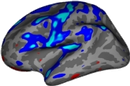
The trouble with this subject has occurred during the white matter segmentation step. Check the surfaces to find the spot that does not match the actual boundaries. If you load the wm.mgz volume as the aux volume you will see a hole in this area. If you are looking in tksurfer you will see a hole or dimple in the inflated surface. You can use the "save point" "goto point" commands to find this spot in the volume. You may need to open other volumes in order to see or fix the problem.
Click here for detailed instructions on how you can fix it. You can also compare this to the finished version, wm1_edits_after.
Edits to the brainmask volume
Now, take a look at the next subject, pial_edits_before.
tkmedit pial_edits_before brainmask.mgz \
  lh.white -aux T1.mgz -aux-surface rh.white
Again, this will bring up the brainmask.mgz volume, the T1.mgz volume, and the surfaces for both hemispheres.
In your second terminal window, if not already open, open the surfaces in tksurfer:
tksurfer pial_edits_before lh inflated &
tksurfer pial_edits_before rh inflated &
This will open the inflated surfaces for both hemispheres in tksurfer.
The trouble with this subject has occurred while making the final surfaces. Check the final surfaces (pial and white surfaces) to make sure that they follow the actual boundaries and that they do not include anything that should not be included.
You may need to open other volumes in order to see or fix the problem.
Click here for detailed instructions on how you can fix it.
Skull strip
Now, take a look at the next subject, skullstrip1_before, in tkmedit.
tkmedit skullstrip1_before brainmask.mgz \
  lh.white -aux T1.mgz -aux-surface rh.white
This will open the brainmask.mgz volume, the T1.mgz loaded as aux, and the surfaces for both hemispheres.
The trouble with this subject has occurred in the skull stripping step. Check the brainmask.mgz volume carefully, comparing it to the T1.mgz volume (loaded in aux) to make sure that the skull has been completely stripped away, leaving behind the complete cortex and the cerebellum.
You can feel free to open other volumes in aux or to load in the aseg.mgz if you want or need to.
Click here for detailed instructions on how you can fix it. You can also compare this to the finished version, skullstrip1_after.
Adding control points
Now, take a look at the next subject, cp_before.
tkmedit cp_before brainmask.mgz \
  lh.white -aux T1.mgz -aux-surface rh.white
Again, this will bring up the brainmask.mgz volume, the T1.mgz volume, and the surfaces for both hemispheres.
In your second terminal window, if not already open, open the surfaces in tksurfer:
tksurfer cp_before lh inflated &
tksurfer cp_before rh inflated &
This will open the inflated surfaces for both hemispheres in tksurfer.
The trouble with this subject has occured during the intensity normalization. Check the white surface and be sure it is including all of the white matter as it should. If you find an area that is not included as white matter be sure to check to see that the intensity is at (or very close to) 110.
You may need to open other volumes in order to see or fix the problem.
Click here for detailed instructions on how you can fix it.
Talairach transformation
Now, take a look at the next subject, tal_before.
tkmedit tal_before brainmask.mgz \
  lh.white -aux T1.mgz -aux-surface rh.white
Again, this will bring up the brainmask.mgz volume and the T1.mgz volume and the surfaces for both hemispheres.
In your second terminal window, if not already open, open the surfaces in tksurfer:
tksurfer tal_before lh inflated &
tksurfer tal_before rh inflated &
This will open the inflated surfaces for both hemispheres in tksurfer.
The trouble with this subject is a little tricky to figure out. The midline cutting planes are not actually on the midline, but the real root of this problem is in one of the very initial steps of recon-all. The talairach transform is bad and will need to be fixed.
You may need to open other volumes in order to see or fix the problem.
Click here for detailed instructions on how you can fix it.