|
Size: 6879
Comment:
|
← Revision 26 as of 2017-03-28 16:56:41 ⇥
Size: 6304
Comment:
|
| Deletions are marked like this. | Additions are marked like this. |
| Line 4: | Line 4: |
| * To follow this exercise exactly be sure you've downloaded the [[FsTutorial/Data|tutorial data set]] before you begin. If you choose not to download the data set you can follow these instructions on your own data, but you will have to substitute your own specific paths and subject names. | * To follow this exercise exactly, be sure you've downloaded the [[FsTutorial/Data|tutorial data set]] before you begin. If you choose not to download the data set you can follow these instructions on your own data, but you will have to substitute your own specific paths and subject names. |
| Line 6: | Line 6: |
| Occasionally, the skull stripping step either removes more than just the skull, causing part of the brain to be removed as well, or too little, leaving behind portions of the skull. Both of these problems need to be corrected before continuing to the next step, either by manually editing the volumes or by adjusting input parameters to the skull stripping step, and running the skull strip again until a good result is obtained. Often the sagittal view reveals skull strip failures. Note that the inflated 3D surface is a less reliable gauge of skull strip failure unless large portions of the brain are missing, or lots of skull is retained. | Occasionally, the skull stripping step either removes more than just the skull, causing part of the brain to be removed as well, or too little, leaving behind portions of the skull. In most cases, both of these problems need to be corrected before continuing to the next step, either by manually editing the volumes or by adjusting input parameters to the skull stripping step, and running the skull strip again until a good result is obtained. However, if portions of the skull are left behind but they do not affect the pial or white surface (as the image below suggests), this is not considered to be an error. The red arrow indicates a portion of dura and skull that were not removed during the skull stripping step. |
| Line 8: | Line 8: |
| skullstrip1_before has a poor skull strip, an entire hemisphere of the cerebellum has been stripped away along with the skull. This page will walk you through the process of fixing this particular subject and also offer suggestions for fixing other common skull stripping problems. | Often the sagittal view reveals skull strip failures. Note that the inflated 3D surface is a less reliable gauge of skull strip failure unless large portions of the brain are missing, or lots of skull is retained. {{attachment:skull_strip_dura.jpg||width="375",height="504"}} This page will walk you through the process of fixing a subject with a skull stripping problem. The subject below, skullstrip1_before, has a poor skull strip in which posterior regions of the cortex have been stripped away along with the skull. |
| Line 12: | Line 16: |
| skullstrip1_before/mri/brainmask.mgz \ | skullstrip1_before/mri/brainmask.mgz:colormap=heat:visible=false \ skullstrip1_before/mri/aseg+aparc.mgz \ |
| Line 18: | Line 23: |
| If you look at coronal slice 91 for skullstrip1_before you can see that the brainmask.mgz volume (the first picture) is missing the right hemisphere of the cerebellum and that it is present in the T1.mgz volume (the second picture). Note that Freesurfer displays slices in radiological view so the right hemisphere cerebellum skull strip issue is seen here on the left side: | You can see that the segmentation and surfaces exclude some cortex in sagittal slice 101 (first image), and if you show the heat-mapped brainmask over the T1 volume (second image), you will see that these issues stem from a bad skull strip. |
| Line 20: | Line 25: |
| {{attachment:subj1_brainmask.jpg||height="304",width="375"}} | {{attachment:SkullStripFix_freeview.jpeg||height="350"}} |
| Line 22: | Line 27: |
| {{attachment:subj1_T1.jpg||height="304",width="375"}} In general there are two ways to fix a volume when there is something missing from the cortex or cerebellum, you can clone the missing pieces in manually or you can adjust the parameters of mri_watershed to do it automatically. For this case, because there is such a lot missing on so many slices you should adjust the parameters of mri_watershed. |
In general, there are two ways to fix a volume when there is something missing from the cortex or cerebellum - you can either clone in the missing pieces manually or adjust the parameters of mri_watershed to do it automatically. For this case, the easiest fix is to adjust the parameters of mri_watershed. |
| Line 27: | Line 30: |
| The watershed algorithm is used during the skull stripping step to find a boundary between the brain and skull. The mri_watershed program uses a default preflooding height of 25 percent. If we want the algorithm to be more conservative (i.e. if part of the brain has been removed), you will want to make that number larger than 25. If you want the algorithm to be more aggressive (i.e. part of the skull has been left behind), you will want to make the height less than 25. There aren't any hard and fast rules about how to select your height value. You can adjust the preflooding height by passing the following flag to recon-all: | The watershed algorithm is used during the skull stripping step to find a boundary between the brain and skull. If you want the algorithm to be more conservative (i.e. if part of the brain has been removed), you will want to decrease the watershed preflooding height percentage, and if you want the algorithm to be more aggressive (i.e. part of the skull has been left behind), you will want to increase the height. You can adjust the preflooding height by passing the following flags to recon-all: |
| Line 32: | Line 35: |
| where <h> is replaced with the preflooding height you'd like to use and <subject name> is replaced with your subject. The clean-bm flag is used to instruct recon-all to write over the old brainmask.mgz volume with your new edits. If you do not use this flag your changes will not take effect. | where <h> is replaced with the preflooding height you'd like to use and <subject name> is replaced with your subject. The clean-bm flag is used to instruct recon-all to write over the old brainmask.mgz volume with your new edits. If you do not use this flag, your changes will not take effect. |
| Line 34: | Line 37: |
| '''Part of the brain is missing'''<<BR>> Now we will take another look at the first volume we looked at, where part of the cerebellum had been removed. If you suspect that certain anatomy could be an outlier, and may be responsible for making the skullstripping step fail or produce poor results then you can try using the -no-wsgcaatlas flag (wsgcaatlas = with skull gaussian classifier array atlas). You can adjust the watershed threshold by passing the -wsthresh flag to recon-all. In this instance, since too much was removed, we want to raise the watershed threshold so use the command: | '''Part of the brain is missing'''<<BR>> Now we will take another look at the above problem case, where part of the cortex was removed. If you suspect that certain anatomy could be an outlier, and may be responsible for making the skullstripping step fail or produce poor results, then you can try using the -no-wsgcaatlas flag (wsgcaatlas = with skull gaussian classifier array atlas). For this case, try fixing the brainmask by running the watershed command with a few different preflooding heights between 1 and 50: |
| Line 36: | Line 39: |
| ---- | |
| Line 38: | Line 40: |
| recon-all -skullstrip -wsthresh 35 -clean-bm -no-wsgcaatlas -subjid skullstrip1_before | recon-all -skullstrip -wsthresh <h> -clean-bm -no-wsgcaatlas -subjid skullstrip1_before |
| Line 40: | Line 42: |
| ---- Take a look at your output volume (brainmask.mgz has been changed) along with the original T1 volume (T1.mgz), and verify the result of the new skull stripping is correct. |
Take a look at your output volume (brainmask.mgz has been changed) along with the original T1 volume (T1.mgz). |
| Line 43: | Line 44: |
| ---- | |
| Line 46: | Line 46: |
| skullstrip1_after/mri/brainmask.mgz \ -f skullstrip1_after/surf/lh.white:edgecolor=yellow \ skullstrip1_after/surf/lh.pial:edgecolor=red \ skullstrip1_after/surf/rh.white:edgecolor=yellow \ skullstrip1_after/surf/rh.pial:edgecolor=red |
skullstrip1_after/mri/brainmask.mgz:colormap=heat |
| Line 52: | Line 48: |
| ---- It should look like this: <<BR>> {{attachment:subj1_bm_after.jpg||height="304",width="375"}} |
The accurately skull-stripped brainmask should look something like this (sagittal slice 101): {{attachment:SkullStripFix_freeview_002.jpeg||height="350"}} What watershed threshold value did you use to produce an optimal skull strip? Was is between 20 and 30? If so, that's because the default preflooding height is 25, which produces the cleanest skull strip for most cases. There aren't any hard and fast rules about how to select your height value, but as a general rule of thumb, if part of the brain is missing, you should start with a watershed threshold around 35, and if too much skull is remaining, you should start with a threshold of around 15. |
| Line 61: | Line 60: |
| INFO: Care must be taken to thoroughly inspect your data when using -gcut. In particular, inpsect the edges of gm and cerebellum for over-aggressive cutting. Open the brainmask.gcuts.mgz volume in freeview to view the voxels which gcut has removed. We recommend viewing the brainmask.gcuts.mgz overlayed on the T1.mgz to clearly see which voxels have been removed by gcut. | INFO: Care must be taken to thoroughly inspect your data when using -gcut. In particular, inspect the edges of gm and cerebellum for over-aggressive cutting. Open the brainmask.gcuts.mgz volume in freeview to view the voxels which gcut has removed. We recommend viewing the brainmask.gcuts.mgz overlayed on the T1.mgz to clearly see which voxels have been removed by gcut. |
| Line 63: | Line 62: |
| {{attachment:brainmask_gcuts_sag.jpg||height="379px",width="434px"}} {{attachment:brainmask_gcuts_cor.jpg||height="379px",width="434px"}} {{attachment:brainmask_gcuts_axial.jpg||height="378px",width="431px"}} == Use talairach_with_skull_2.lta == During the skull-strip stage, the registration file {{{talairach_with_skull.lta}}} is created by mri_em_register in order to make use of the atlas to find skull. But in the autorecon2 stage, the registration file {{{talairach_with_skull_2.lta}}} is created, and this one is created with the benefit of the mri_ca_register stage, and so tends to be a tiny bit more accurate than {{{talairach_with_skull.lta}}}, and so it is possible that the skull-strip will work better with this registration file. So to make use of it: {{{ cd $SUBJECTS_DIR/yoursubj/mri/transforms cp talairach_with_skull.lta bak cp talairach_with_skull_2.lta talairach_with_skull.lta recon-all -s yoursubj -skullstrip -clean-bm -clean-lta }}} Inspect the brainmask.mgz after this completes. |
{{attachment:brainmask_gcuts_sag.jpg||width="434px",height="379px"}} {{attachment:brainmask_gcuts_cor.jpg||width="434px",height="379px"}} {{attachment:brainmask_gcuts_axial.jpg||width="431px",height="378px"}} |
| Line 77: | Line 65: |
| After the bad skull strip has been improved, you can run the following command to regenerate Freesurfer output based on the new brainmask.mgz. | After the bad skull strip has been improved, you can run the following command to regenerate Freesurfer output based on the new brainmask.mgz: |
Fixing a bad skull strip
To follow this exercise exactly, be sure you've downloaded the tutorial data set before you begin. If you choose not to download the data set you can follow these instructions on your own data, but you will have to substitute your own specific paths and subject names.
Occasionally, the skull stripping step either removes more than just the skull, causing part of the brain to be removed as well, or too little, leaving behind portions of the skull. In most cases, both of these problems need to be corrected before continuing to the next step, either by manually editing the volumes or by adjusting input parameters to the skull stripping step, and running the skull strip again until a good result is obtained. However, if portions of the skull are left behind but they do not affect the pial or white surface (as the image below suggests), this is not considered to be an error. The red arrow indicates a portion of dura and skull that were not removed during the skull stripping step.
Often the sagittal view reveals skull strip failures. Note that the inflated 3D surface is a less reliable gauge of skull strip failure unless large portions of the brain are missing, or lots of skull is retained.
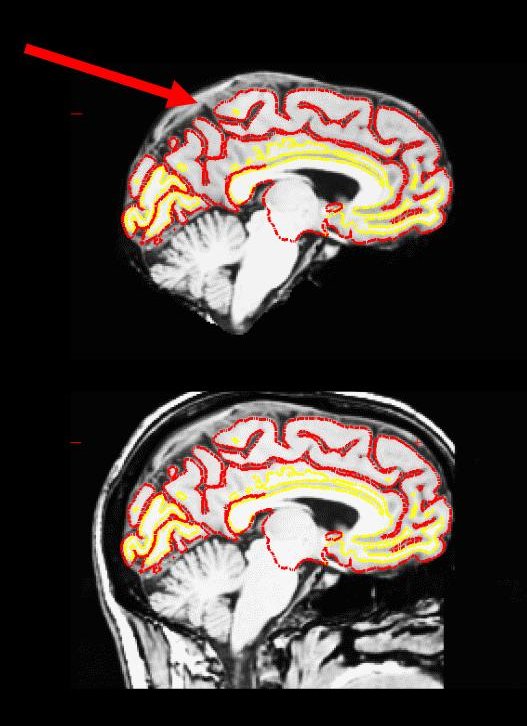
This page will walk you through the process of fixing a subject with a skull stripping problem. The subject below, skullstrip1_before, has a poor skull strip in which posterior regions of the cortex have been stripped away along with the skull.
freeview -v skullstrip1_before/mri/T1.mgz \
skullstrip1_before/mri/brainmask.mgz:colormap=heat:visible=false \
skullstrip1_before/mri/aseg+aparc.mgz \
-f skullstrip1_before/surf/lh.white:edgecolor=yellow \
skullstrip1_before/surf/lh.pial:edgecolor=red \
skullstrip1_before/surf/rh.white:edgecolor=yellow \
skullstrip1_before/surf/rh.pial:edgecolor=red
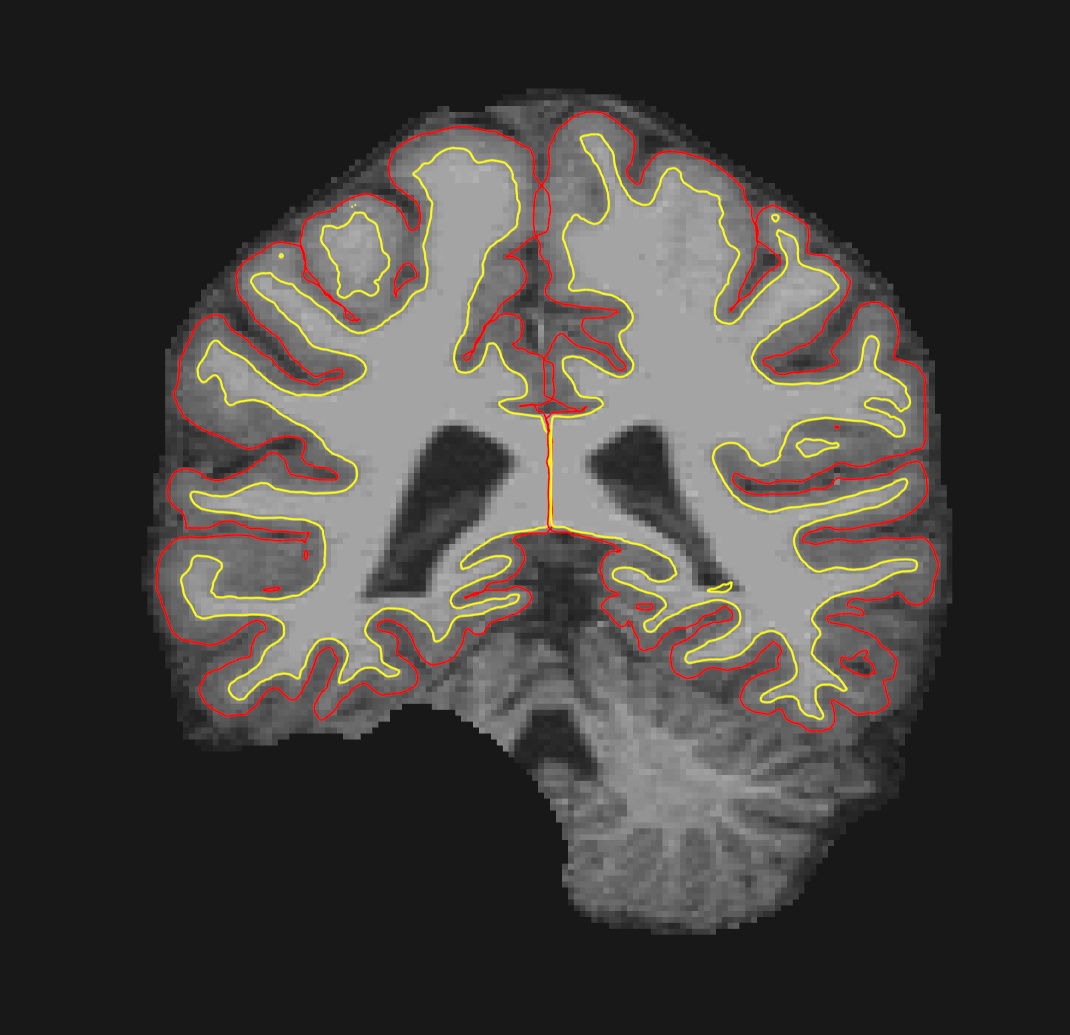
You can see that the segmentation and surfaces exclude some cortex in sagittal slice 101 (first image), and if you show the heat-mapped brainmask over the T1 volume (second image), you will see that these issues stem from a bad skull strip.
In general, there are two ways to fix a volume when there is something missing from the cortex or cerebellum - you can either clone in the missing pieces manually or adjust the parameters of mri_watershed to do it automatically. For this case, the easiest fix is to adjust the parameters of mri_watershed.
Adjusting watershed parameters
The watershed algorithm is used during the skull stripping step to find a boundary between the brain and skull. If you want the algorithm to be more conservative (i.e. if part of the brain has been removed), you will want to decrease the watershed preflooding height percentage, and if you want the algorithm to be more aggressive (i.e. part of the skull has been left behind), you will want to increase the height. You can adjust the preflooding height by passing the following flags to recon-all:
recon-all -skullstrip -wsthresh <h> -clean-bm -subjid <subject name>
where <h> is replaced with the preflooding height you'd like to use and <subject name> is replaced with your subject. The clean-bm flag is used to instruct recon-all to write over the old brainmask.mgz volume with your new edits. If you do not use this flag, your changes will not take effect.
Part of the brain is missing
Now we will take another look at the above problem case, where part of the cortex was removed. If you suspect that certain anatomy could be an outlier, and may be responsible for making the skullstripping step fail or produce poor results, then you can try using the -no-wsgcaatlas flag (wsgcaatlas = with skull gaussian classifier array atlas). For this case, try fixing the brainmask by running the watershed command with a few different preflooding heights between 1 and 50:
recon-all -skullstrip -wsthresh <h> -clean-bm -no-wsgcaatlas -subjid skullstrip1_before
Take a look at your output volume (brainmask.mgz has been changed) along with the original T1 volume (T1.mgz).
freeview -v skullstrip1_after/mri/T1.mgz \
skullstrip1_after/mri/brainmask.mgz:colormap=heat
The accurately skull-stripped brainmask should look something like this (sagittal slice 101):
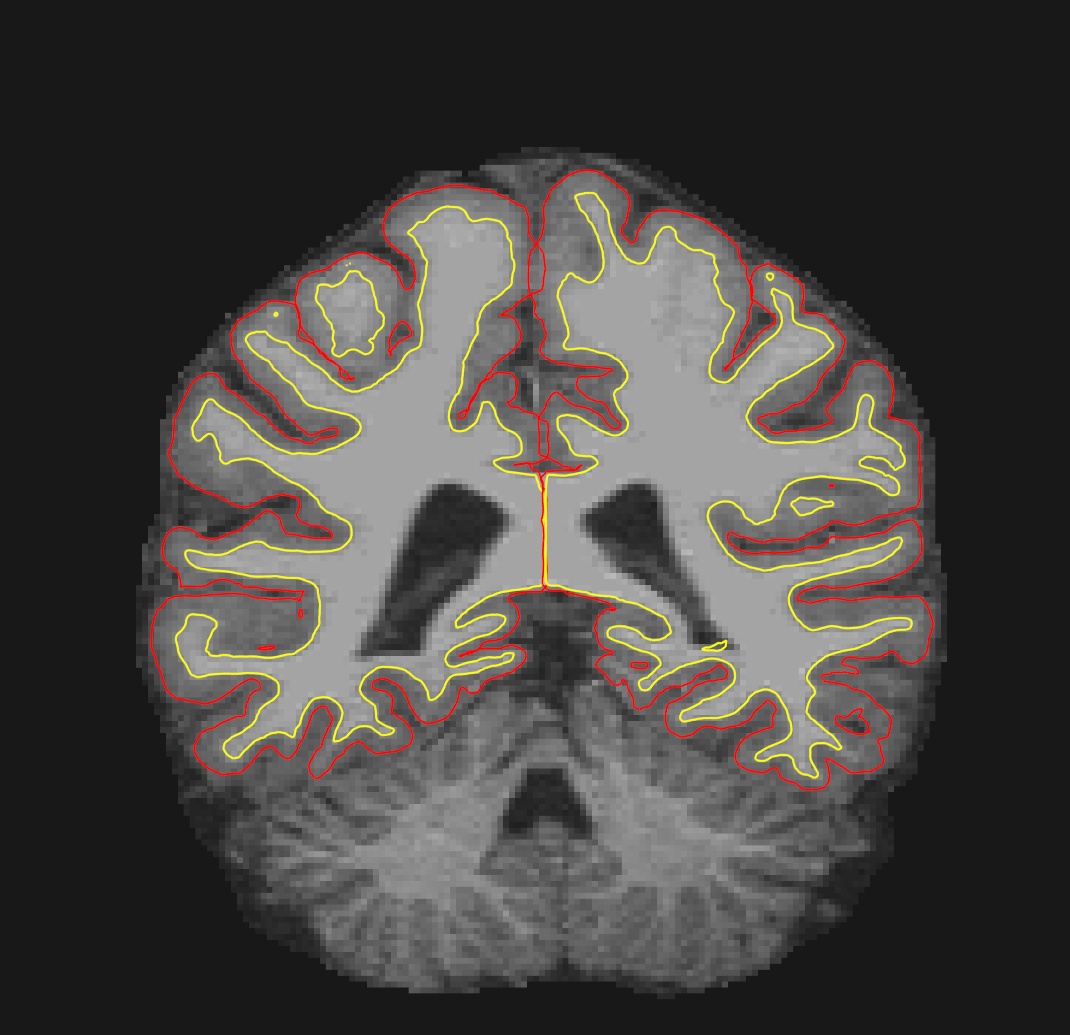
What watershed threshold value did you use to produce an optimal skull strip? Was is between 20 and 30? If so, that's because the default preflooding height is 25, which produces the cleanest skull strip for most cases. There aren't any hard and fast rules about how to select your height value, but as a general rule of thumb, if part of the brain is missing, you should start with a watershed threshold around 35, and if too much skull is remaining, you should start with a threshold of around 15.
Using gcut
When the skull stripping has left a small part of dura left, it is quicker to try and rerun the skullstrip step using the -gcut flag than to do manual editing. This flag removes any extra dura that could influence the surfaces.
recon-all -skullstrip -clean-bm -gcut -subjid <subject name>
INFO: Care must be taken to thoroughly inspect your data when using -gcut. In particular, inspect the edges of gm and cerebellum for over-aggressive cutting. Open the brainmask.gcuts.mgz volume in freeview to view the voxels which gcut has removed. We recommend viewing the brainmask.gcuts.mgz overlayed on the T1.mgz to clearly see which voxels have been removed by gcut.
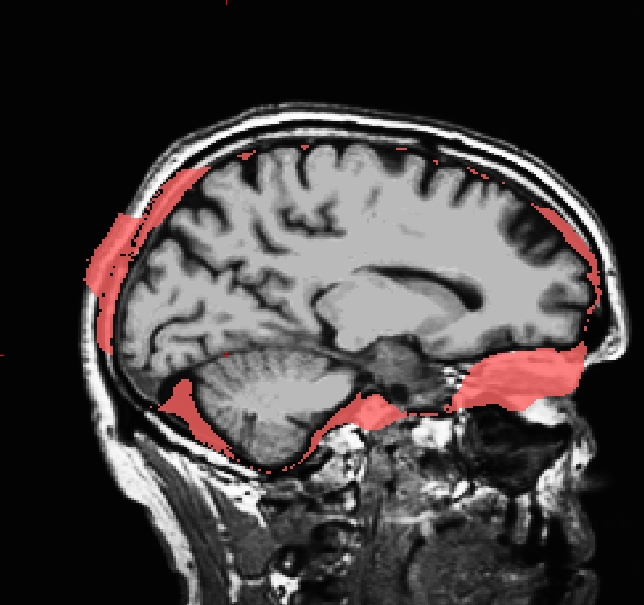
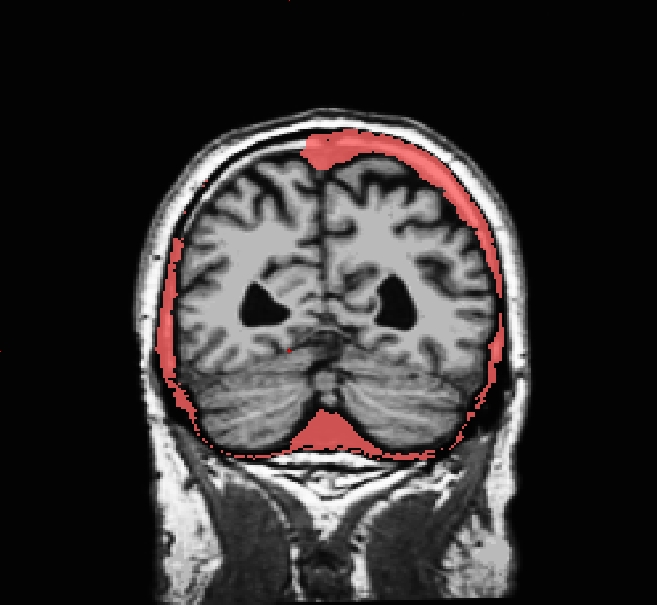
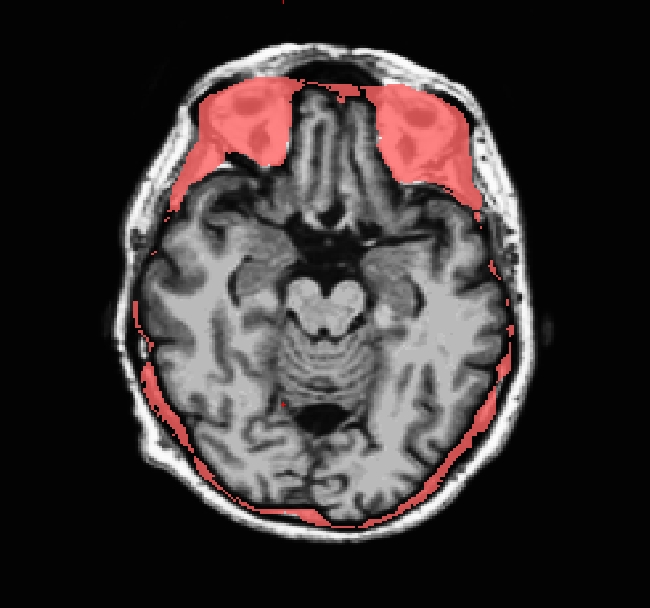
Regenerating surfaces after the bad skull strip is fixed
After the bad skull strip has been improved, you can run the following command to regenerate Freesurfer output based on the new brainmask.mgz:
recon-all -autorecon-pial -subjid <subject name>
Do not run this command if you are conducting the tutorial!