|
Size: 5642
Comment:
|
Size: 6644
Comment:
|
| Deletions are marked like this. | Additions are marked like this. |
| Line 1: | Line 1: |
| Line 3: | Line 2: |
| This page describes how to perform seed-based functional connectivity (FC) analysis in FSFAST. This is an extension of the task-based analysis for which there is much more documentation. It may be worth your time to study some of the preprocessing and task-based analysis as found in [[http://surfer.nmr.mgh.harvard.edu/pub/docs/freesurfer.fsfast.ppt|FS-FAST powerpoint]] | This page describes how to perform seed-based functional connectivity (FC) analysis in FSFAST. This is an extension of the task-based analysis for which there is much more documentation. It may be worth your time to study some of the preprocessing and task-based analysis as found in [[http://surfer.nmr.mgh.harvard.edu/pub/docs/freesurfer.fsfast.ppt|FS-FAST powerpoint]] and the [[http://surfer.nmr.mgh.harvard.edu/fswiki/FsFastTutorial|FS-FAST tutorial]]. |
| Line 9: | Line 8: |
| dcmunpack -src dicomdir/subject/ALLDICOMS -targ fcMRI_dir/subject -fsfast -run 3 bold nii.gz f.nii.gz -run 4 bold nii.gz f.nii.gz | dcmunpack -src dicomdir -targ sessionid -fsfast -run 3 bold nii.gz f.nii.gz -run 4 bold nii.gz f.nii.gz |
| Line 13: | Line 12: |
| * Have all fMRI dicoms linked into "ALLDICOMS" directory * Arguement for "-targ" specifies output directory * -run 3 bold nii.gz f.nii.gz will unpack run 3 fmri to fcMRI_dir/subject/bold/003/f.nii.gz |
* Have all fMRI dicoms for this subject in the dicomdir folder or subfolders under this folder * Arguement for "-targ" specifies output directory here called "sessionid". This should be unique to the subject (and visit if longitudinal). This is called the session folder. * -run 3 bold nii.gz f.nii.gz will unpack run 3 fmri to sessionid/bold/003/f.nii.gz |
| Line 18: | Line 17: |
| * The parent folder of the sessionid folder is called the "Project Folder" or "Project Directory". All the commands below should be run from the Project Folder. | |
| Line 21: | Line 21: |
| *STEP 2: Link to FreeSurfer anatomical analysis: Create "subjectname" text file in the session directory. Write in it the subject's recon directory name (as labeld in $SUBJECTS_DIR). C. Create a sessid file (text file with list of your sessions) in your Study DIR (optional) |
*STEP 2: Link to FreeSurfer anatomical analysis. This is done by creating a text file called sessionid/subjectname with the name of the FreeSurfer anatomical folder as created with recon-all and found in $SUBJECTS_DIR. |
| Line 29: | Line 27: |
| preproc-sess -s <subjid> -fwhm <#> | preproc-sess -s sessionid -fwhm 10 -surface fsaverage lhrh |
| Line 31: | Line 29: |
| A. By default this will do motion correction, smoothing & brain masking | By default this will do motion correction, masking, registration to the anatomical, sampling to the surface, and surface smoothing. The sampling is done onto the surface of the lh and rh hemispheres of fsaverage. Note that eventhough the time series data are sampled onto fsaverage, the FC seeds are derived from the indvidual anatomy as shown below. |
| Line 33: | Line 31: |
| B. Quality Check (plot-twf-sess) | *STEP 4: |
| Line 35: | Line 33: |
| C.Examine additions to FSFAST hierarchy (in each run of bold dir): | There are two methods of deriving a seed region: |
| Line 37: | Line 35: |
| ||f.nii ||(Raw fMRI data) || ||fmc.nii ||(Motion corrected-MC) || ||fmcsm5.nii ||(MC & smoothed) || ||fmc.mcdat ||(Text file with the MC parameters (AFNI)) || ||brain.mgz ||(Binary mask of the brain) || NOTE: you ''may'' need to convert the file "fmcpr.mgz" to fmcpr.nii using [[http://surfer.nmr.mgh.harvard.edu/fswiki/mri_convert|mri_convert]] Found in each bold scan dir. Sample cmd: mri_convert session/bold/002/fmcpr.mgz session/bold/002/fmcpr.nii mri_convert session/bold/003/fmcpr.mgz session/bold/003/fmcpr.nii Next, I'll outline two methods of deriving a seed region: 1) To use a full-size Freesurfer parcellation from aparc+aseg.mgz, continue with STEP 4 on this page. |
1) To use a full-size Freesurfer parcellation from aparc+aseg.mgz, continue with STEP 5 on this page. |
| Line 61: | Line 39: |
| *STEP 4: Use fcseed-config to record the parameters you wish to pass to your connectivity analysis. | *STEP 5: Use fcseed-config to configure the parameters you wish to pass to your connectivity analysis. |
| Line 64: | Line 42: |
| fcseed-config -segid 1010 -fcname mean.L_Posteriorcingulate.dat -fsd bold -mean -cfg mean.L_Posteriorcingulate.config | {{{fcseed-config -segid 1010 -fcname mean.L_Posteriorcingulate.dat -fsd bold -mean -cfg mean.L_Posteriorcingulate.config}}} |
| Line 66: | Line 44: |
| This example will use the FreeSurfer cortical segmentation for the left posterior cingulate (segID: 1010). For seed regions, we recommend generating the mean signal timecourse by using "-mean" | This example will use the FreeSurfer cortical segmentation for the left posterior cingulate (segID: 1010) as defined for this individual. For seed regions, we recommend generating the mean signal timecourse by using "-mean". Note that this does not perform any analysis, it just creates a text file with the configuration. You can include more -segid flags to include more regions (though it will create only one seed time course). NOTE: Once a config file is created it may be used for multiple sessions. |
| Line 70: | Line 48: |
| Sample cmd (mean seed region timecourse): | {{{fcseed-sess -s sessionid -cfg L_Posteriorcingulate.config}}} |
| Line 72: | Line 50: |
| fcseed-sess -s <session> -cfg mean.L_Posteriorcingulate.config | This creates a file called L_Posteriorcingulate.dat in each resting state run. This will have a single time course in it |
| Line 74: | Line 52: |
| Sample cmd (mean waveforms for nuisance regressors, but PCA also possible with -pca): |
*STEP 6: Create nuisance variables |
| Line 78: | Line 55: |
| . fcseed-config -wm -fcname wm.dat -fsd bold -cfg wm.config . fcseed-sess -s <session> -cfg wm.config |
. fcseed-config -wm -fcname wm.dat -fsd bold -pca -cfg wm.config . fcseed-sess -s sessionid -cfg wm.config |
| Line 82: | Line 59: |
| . fcseed-config -vcsf -fcname vcsf.dat -fsd bold -mean -cfg vcsf.config . fcseed-sess -s <session> -cfg vcsf.config |
. fcseed-config -vcsf -fcname vcsf.dat -fsd bold -pca -cfg vcsf.config . fcseed-sess -s sessionid -cfg vcsf.config |
| Line 85: | Line 62: |
| *NOTE: Once a config file is created it may be used for multiple sessions | These commands will create wm.dat and vcsf.dat in for each resting state run. These are text files with multiple columns. Each column is a principle component. You will choose the number of components to use below. |
| Line 87: | Line 65: |
| *STEP 5: Use [[http://surfer.nmr.mgh.harvard.edu/fswiki/mkanalysis-sess|mkanalysis-sess]] to setup an analysis for your FC data | *STEP 6: Use [[http://surfer.nmr.mgh.harvard.edu/fswiki/mkanalysis-sess|mkanalysis-sess]] to configure an analysis for your FC data. Like the fcseed-config above, this is done once regardless of how many sessionds you have. |
| Line 89: | Line 67: |
| Sample cmd: | {{{mkanalysis-sess -analysis fc.lpccseed.surf.lh -surface fsaverage lh -fwhm 5 -notask -taskreg L_Posteriorcingulate.dat 1 -nuisreg vcsf.dat 5 -nuisreg wm.dat 5 -mcreg -polyfit 5 -nskip 4 -fsd bold -TR <TR> }}} |
| Line 91: | Line 69: |
| mkanalysis-sess -a <analysisname> | This command does not perform any analysis; it just creates an analysis configuration called "fc.lpccseed.surf.lh". There will be a folder of this name with a text file called analysis.info. The analysis will be run on the left hemisphere of fsaverage smoothed by 5 mm (this was already performed in preprocessing above). The waveform in the file called mean.L_Posteriorcingulate.dat will be used as the "task regressor"; this is just the FC seed. There are five sets of nuisance variables: (1) the CSF from which the top 5 principle components will be used, (2) the white matter from which the top 5 principle components will be used, (3) motion correction parameters (-mcreg), (4) 5th order polynomial, and (5) the first 4 time points will be discarded. If you with to perform global signal regression, add "-nuisreg global.waveform.dat 1". Specify the TR with the -TR flag (eg, TR 2 for 2 seconds). |
| Line 93: | Line 71: |
| . -surface fsaverage <hemi> -notask -taskreg mean.L_Posteriorcingulate.dat 1 -nuisreg vcsfreg.dat 1 -nuisreg wmreg.dat 1 -nuisreg global.waveform.dat 1 -fwhm 5 -fsd bold -TR <TR> -mcextreg -polyfit 5 -nskip 4 | *STEP 6: Use [[http://surfer.nmr.mgh.harvard.edu/fswiki/selxavg3-sess|selxavg3-sess]] to run the subject-level analysis outlined by the above mkanalysis-sess cmd just as you would with a task-based analysis |
| Line 95: | Line 73: |
| Note: if you do not want to regress out the global signal, then do not include it in the mkanalysis-sess command. |
{{{selxavg3-sess -s sessionid -a fc.lpccseed.surf.lh}}} |
| Line 98: | Line 75: |
| *STEP 6: Use [[http://surfer.nmr.mgh.harvard.edu/fswiki/selxavg3-sess|selxavg3-sess]] to run the subject-level analysis outlined by the above mkanalysis-sess cmd. . selxavg3-sess -s <session> -a <analysisname> *STEP 7: Choose the contrast file (generated in each session's contrast directory) that you wish to analyze on a group level: |
This performs the voxel-wise time series analysis for the given session. This results in several files being generated in the session folder. These include |
| Line 109: | Line 82: |
| *STEP 8: To continue with a group-level analysis, try one of the methods below: Method 1: *create fsgd file containing all sessions of interest *Concatenate contrast files using [[http://www.freesurfer.net/fswiki/mri_concat|mri_concat]] *Run group analysis using [[http://www.freesurfer.net/fswiki/mri_concat|mri_glmfit]] |
*STEP 7: Group-level analysiss |
| Line 115: | Line 84: |
| Should also be possible with: Method 2: *[[http://www.freesurfer.net/fswiki/Qdec|Qdec]] |
As with task-based analysis, you will run isxconcat-sess to create a "stack" of maps from each subject. If you want to use the correlation coefficient instead of the ces, specify -map pcc. Specify the contrast as L_Posteriorcingulate (or just use -all-contrasts). After that, you can perform the standard group FS group analysis. |
| Line 119: | Line 86: |
| Should also be possible with: Method 3: *Concatenate with [[http://www.freesurfer.net/fswiki/isxconcat-sess|isxconcat-sess]] *Run group analysis using [[http://www.freesurfer.net/fswiki/mri_concat|mri_glmfit]] |
About
This page describes how to perform seed-based functional connectivity (FC) analysis in FSFAST. This is an extension of the task-based analysis for which there is much more documentation. It may be worth your time to study some of the preprocessing and task-based analysis as found in FS-FAST powerpoint and the FS-FAST tutorial.
*STEP 1: Unpack Data into the FSFAST Hierarchy using dcmunpack (run with -help for more documentation):
Sample cmd:
dcmunpack -src dicomdir -targ sessionid -fsfast -run 3 bold nii.gz f.nii.gz -run 4 bold nii.gz f.nii.gz
In this sample command...
- Have all fMRI dicoms for this subject in the dicomdir folder or subfolders under this folder
- Arguement for "-targ" specifies output directory here called "sessionid". This should be unique to the subject (and visit if longitudinal). This is called the session folder.
- -run 3 bold nii.gz f.nii.gz will unpack run 3 fmri to sessionid/bold/003/f.nii.gz
- To get a list of runs, run dcmunpack -src dicomdir/subject/ALLDICOMS
- Use "-fsfast" to generate fsfast hierarchy shown in the image below
- The parent folder of the sessionid folder is called the "Project Folder" or "Project Directory". All the commands below should be run from the Project Folder.
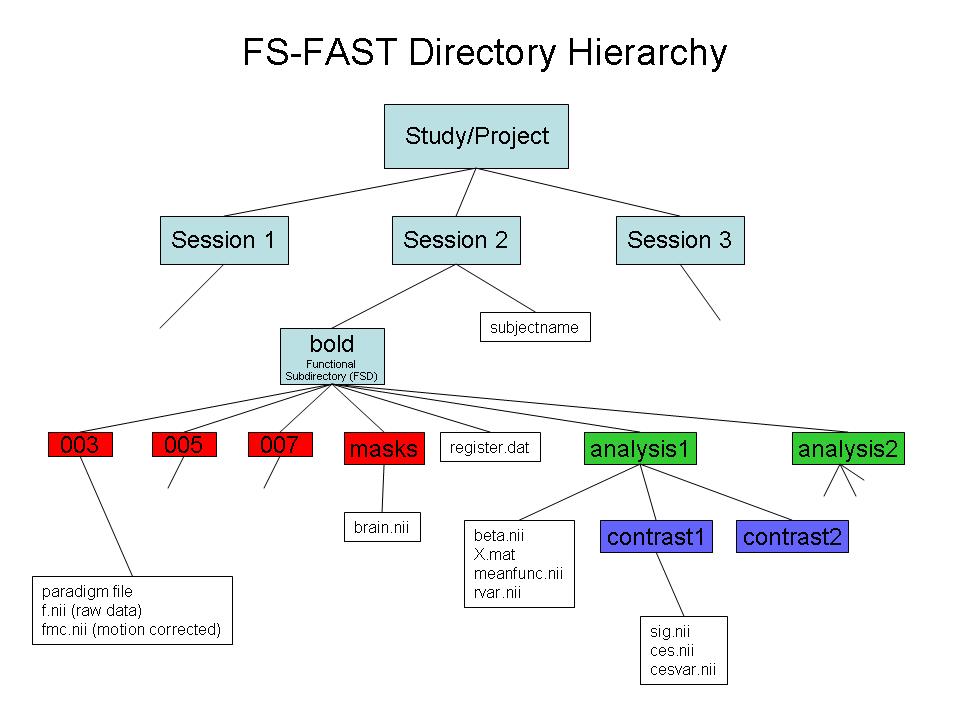
*STEP 2: Link to FreeSurfer anatomical analysis. This is done by creating a text file called sessionid/subjectname with the name of the FreeSurfer anatomical folder as created with recon-all and found in $SUBJECTS_DIR.
*STEP 3: Pre-process your bold data using preproc-sess preproc-sess
Sample cmd:
preproc-sess -s sessionid -fwhm 10 -surface fsaverage lhrh
By default this will do motion correction, masking, registration to the anatomical, sampling to the surface, and surface smoothing. The sampling is done onto the surface of the lh and rh hemispheres of fsaverage. Note that eventhough the time series data are sampled onto fsaverage, the FC seeds are derived from the indvidual anatomy as shown below.
*STEP 4:
There are two methods of deriving a seed region:
1) To use a full-size Freesurfer parcellation from aparc+aseg.mgz, continue with STEP 5 on this page.
2) To split the full Freesurfer parcellation into multiple seeds ("split parcellation"), follow the additional steps here - and resume with step 5 on this page...
*STEP 5: Use fcseed-config to configure the parameters you wish to pass to your connectivity analysis.
Sample command: fcseed-config -segid 1010 -fcname mean.L_Posteriorcingulate.dat -fsd bold -mean -cfg mean.L_Posteriorcingulate.config
This example will use the FreeSurfer cortical segmentation for the left posterior cingulate (segID: 1010) as defined for this individual. For seed regions, we recommend generating the mean signal timecourse by using "-mean". Note that this does not perform any analysis, it just creates a text file with the configuration. You can include more -segid flags to include more regions (though it will create only one seed time course). NOTE: Once a config file is created it may be used for multiple sessions.
*STEP 5: Pass the config text file to fcseed-sess to generate time-course information for your chosen seed region (or for nuisance variable signal).
fcseed-sess -s sessionid -cfg L_Posteriorcingulate.config
This creates a file called L_Posteriorcingulate.dat in each resting state run. This will have a single time course in it
*STEP 6: Create nuisance variables
for white matter:
- fcseed-config -wm -fcname wm.dat -fsd bold -pca -cfg wm.config
- fcseed-sess -s sessionid -cfg wm.config
for ventricles + CSF:
- fcseed-config -vcsf -fcname vcsf.dat -fsd bold -pca -cfg vcsf.config
- fcseed-sess -s sessionid -cfg vcsf.config
These commands will create wm.dat and vcsf.dat in for each resting state run. These are text files with multiple columns. Each column is a principle component. You will choose the number of components to use below.
*STEP 6: Use mkanalysis-sess to configure an analysis for your FC data. Like the fcseed-config above, this is done once regardless of how many sessionds you have.
mkanalysis-sess -analysis fc.lpccseed.surf.lh -surface fsaverage lh -fwhm 5 -notask -taskreg L_Posteriorcingulate.dat 1 -nuisreg vcsf.dat 5 -nuisreg wm.dat 5 -mcreg -polyfit 5 -nskip 4 -fsd bold -TR <TR>
This command does not perform any analysis; it just creates an analysis configuration called "fc.lpccseed.surf.lh". There will be a folder of this name with a text file called analysis.info. The analysis will be run on the left hemisphere of fsaverage smoothed by 5 mm (this was already performed in preprocessing above). The waveform in the file called mean.L_Posteriorcingulate.dat will be used as the "task regressor"; this is just the FC seed. There are five sets of nuisance variables: (1) the CSF from which the top 5 principle components will be used, (2) the white matter from which the top 5 principle components will be used, (3) motion correction parameters (-mcreg), (4) 5th order polynomial, and (5) the first 4 time points will be discarded. If you with to perform global signal regression, add "-nuisreg global.waveform.dat 1". Specify the TR with the -TR flag (eg, TR 2 for 2 seconds).
*STEP 6: Use selxavg3-sess to run the subject-level analysis outlined by the above mkanalysis-sess cmd just as you would with a task-based analysis
selxavg3-sess -s sessionid -a fc.lpccseed.surf.lh
This performs the voxel-wise time series analysis for the given session. This results in several files being generated in the session folder. These include
- # ces.mgz - contrast effect size (contrast matrix * regression coef) # cesvar.mgz - variance of contrast effect size # sig.mgz - significance map (-log10(p)) # pcc.mgz - partial correlation coefficient map
*STEP 7: Group-level analysiss
As with task-based analysis, you will run isxconcat-sess to create a "stack" of maps from each subject. If you want to use the correlation coefficient instead of the ces, specify -map pcc. Specify the contrast as L_Posteriorcingulate (or just use -all-contrasts). After that, you can perform the standard group FS group analysis.