|
Size: 3000
Comment:
|
Size: 4893
Comment:
|
| Deletions are marked like this. | Additions are marked like this. |
| Line 1: | Line 1: |
| [[FreeSurferWiki|top]] |
|
| Line 3: | Line 5: |
| !FreeSurfer is a freely available software package developed by investigators at the [http://www.nmr.mgh.harvard.edu: Athinoula A. Martinos Center for Biomedical Imaging] used for a number of procedures including: 1. Creation of computerized models of the brain from magnetic resonance imaging (MRI) data [RECON link here] |
!FreeSurfer is a freely available software package developed by investigators at the [[http://www.nmr.mgh.harvard.edu:|Athinoula A. Martinos Center for Biomedical Imaging]] used for a number of procedures including: |
| Line 7: | Line 7: |
| 2. Processing of functional magnetic resonance imaging (fMRI) data [FSFAST link here] | 1. Creation of computerized models of the brain from magnetic resonance imaging (MRI) data. |
| Line 9: | Line 9: |
| 3. Measuring a number of morphometric properties of the brain including cortical thickness and regional volumes [THICKNESS wiki link] | 2. Processing of functional magnetic resonance imaging (fMRI) data. |
| Line 11: | Line 11: |
| 4. Intersubject averaging of structural and functional using a procedure that aligns individuals based on their cortical folding patterns for optimal alignment of homologous neural regions [SPHERICAL wiki link] | 3. Measuring a number of morphometric properties of the brain including cortical thickness and regional volumes. 4. Intersubject averaging of structural and functional data using a procedure that aligns individuals based on their cortical folding patterns for optimal alignment of homologous neural regions. |
| Line 14: | Line 16: |
| To run Freesurfer, you will need either a PC running Linux or a Macintosh running OSX (OPTIMAL MACHINE wiki link- I think even a linke quote for a machine woud be best). | To run FreeSurfer, you will need either a PC running Linux or a Macintosh running OS X. FreeSurfer consumes a lot of processor time, memory resources and disk space, so it is recommended to run FreeSurfer on as powerful a machine as you have available. For example, at MGH we typically run Linux CentOS 5 on 2.5GHz quad processor Intel Xeon with 4 to 8 GB of DDR SDRAM, and 500GB of disk space. See SystemRequirements for more info. |
| Line 17: | Line 24: |
| The processing procedures for the creation of cortical models requires good quality T1 weighted MRI data, such as a Siemens MPRAGE ([http://www.nmr.mgh.harvard.edu/~andre/: examples of appropriate Siemens scanner protocols])or GE SPGR sequence with approximately 1mm^3 resolution (although a variety of quality datasets can be processed with additional manual intervention). | The processing procedures for the creation of cortical models require good quality T1 weighted MRI data, such as a Siemens MPRAGE ([[http://surfer.nmr.mgh.harvard.edu/fswiki/FreeSurferWiki?action=AttachFile&do=get&target=FreeSurfer_Suggested_Morphometry_Protocols.pdf|examples of appropriate Siemens scanner protocols]]) or GE SPGR sequence with approximately 1mm^3^ resolution (although a variety of quality data sets can be processed with additional manual intervention). Thickness should not exceed 1.5mm (~1mm^3 is ideal). [[http://adni.loni.ucla.edu/methods/documents/mri-protocols/|The protocols specified for the ADNI project are excellent examples to follow.]] The best FreeSurfer processing results come from scans having excellent gray/white matter contrast. {{attachment:example_scan_A.jpg}} {{attachment:example_scan_B.jpg}} {{attachment:example_scan_C.jpg}} * '''A''' - excellent GM/WM contrast, acquired with MP-RAGE pulse-sequence protocol * '''B''' - very good GM/WM contrast, acquired with MP-RAGE pulse-sequence protocol * '''C''' - good GM/WM contrast, acquired with SPGR pulse-sequence protocol; not as good GM/WM contrast as the MP-RAGE acquisitions; low bandwidth causes some temporal lobe artifacts (brightening of the gray matter) These example scans, captured from FreeSurfer's tkmedit display, are slices from the brainmask.mgz file, created by the -autorecon1 stage of FreeSurfer (requiring about 20 minutes of processing time). This means that some amount of intensity normalization has occurred, but the contrast differences between image examples are easier to see, compared to the original (orig.mgz) volume. Refer to the tutorial sections [[FsTutorial/ControlPoints|'Using Control Points to Fix Intensity Normalization']] and [[FsTutorial/WhiteMatterEdits|'Fixing Common Geometric Inaccuracies in White Matter Surfaces']] for examples of problem areas resulting from scan deficiencies. '''Getting Started''' There is a variety of documentation about the use of FreeSurfer contained in the FreeSurfer wiki including [[DownloadAndInstall|installation of the software]], [[FsTutorial|tutorials]], [[FsTutorial/Data|sample data]], and [[WorkFlows|work flows]] providing step by step guides to performing specific tasks. To get started, we suggest you: 1. Read the links to slides marked as type 'talk' in the tutorials: [[FsTutorial|click here]] 2. Read the background material: [[https://www.zotero.org/freesurfer|click here]] 3. Install FreeSurfer: [[DownloadAndInstall|click here]] 4. Download the sample data set: [[FsTutorial/Data|click here]] 5. Follow the cortical reconstruction tutorial to create cortical models: [[FsTutorial|click here]] 6. Follow the reconstruction workflow page: [[RecommendedReconstruction|click here]] 7. Peruse the wiki to get a fuller knowledge of all of the available processing procedures in the FreeSurfer software package 8. Process your own data with a command such as this: {{{ recon-all \ -i <one slice in the anatomical dicom series> \ -s <subject id that you make up> \ -sd <directory to put the subject folder in> \ -all }}} |
| Line 20: | Line 66: |
| '''''TO DOWNLOAD THE SOFTWARE:''''' [wiki:Self:DownloadAndInstall follow this link] | An active [[FreeSurferSupport|e-mail list]] is available to answer specific questions about processing procedures. |
| Line 22: | Line 68: |
| == Overview == An overview of the major processing steps taking place in a standard !FreeSurfer workflow are described in this PDF slide presentation: [http://surfer.nmr.mgh.harvard.edu/docs/ftp/pub/docs/FSL_anatomical_stream.pdf Building Anatomical Models with Freesurfer]. See also: FreeSurferAnalysisPipelineOverview '''Data Requirements: MRI Parameters''' FreeSurfer requires that the MRI data conform to certain parameters. The slice thickness should be 1.3mm and the Field of View should be 256mm. To see examples of appropriate Siemens scanner protocols, refer to: http://www.nmr.mgh.harvard.edu/~andre/ For best results, each subject should have at least one sagittal structural scan. These scans are averaged and automatically corrected for motion before further processing. The end result: FreeSurfer will produce a single, high quality 3D structural volume, corresponding 2D surfaces, and automatically segmented subcortical structures for each of your subjects. You can also use FreeSurfer to generate an average subject out of all the participants in your study, upon which you can display individual subject data -- structural and/or functional -- thus making FreeSurfer a practical option for individual and group analyses. '''Work Flows''' Consult the WorkFlows section to learn the detailed workings of a FreeSurfer processing stream. |
There is also a [[UserContributions/FAQ|FAQ]] |
FreeSurfer Beginners Guide
FreeSurfer is a freely available software package developed by investigators at the Athinoula A. Martinos Center for Biomedical Imaging used for a number of procedures including:
- Creation of computerized models of the brain from magnetic resonance imaging (MRI) data.
- Processing of functional magnetic resonance imaging (fMRI) data.
- Measuring a number of morphometric properties of the brain including cortical thickness and regional volumes.
- Intersubject averaging of structural and functional data using a procedure that aligns individuals based on their cortical folding patterns for optimal alignment of homologous neural regions.
Machine Requirements
To run FreeSurfer, you will need either a PC running Linux or a Macintosh running OS X.
FreeSurfer consumes a lot of processor time, memory resources and disk space, so it is recommended to run FreeSurfer on as powerful a machine as you have available. For example, at MGH we typically run Linux CentOS 5 on 2.5GHz quad processor Intel Xeon with 4 to 8 GB of DDR SDRAM, and 500GB of disk space.
See SystemRequirements for more info.
Data Requirements
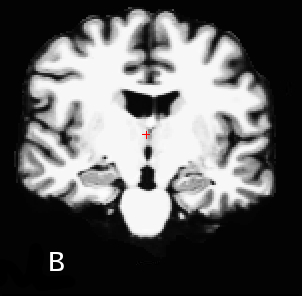
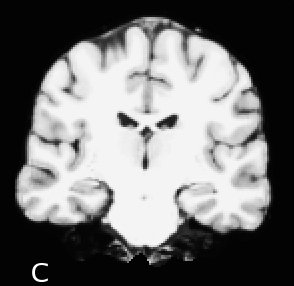
The processing procedures for the creation of cortical models require good quality T1 weighted MRI data, such as a Siemens MPRAGE (examples of appropriate Siemens scanner protocols) or GE SPGR sequence with approximately 1mm3 resolution (although a variety of quality data sets can be processed with additional manual intervention). Thickness should not exceed 1.5mm (~1mm^3 is ideal). The protocols specified for the ADNI project are excellent examples to follow. The best FreeSurfer processing results come from scans having excellent gray/white matter contrast.
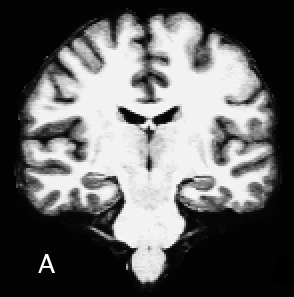
A - excellent GM/WM contrast, acquired with MP-RAGE pulse-sequence protocol
B - very good GM/WM contrast, acquired with MP-RAGE pulse-sequence protocol
C - good GM/WM contrast, acquired with SPGR pulse-sequence protocol; not as good GM/WM contrast as the MP-RAGE acquisitions; low bandwidth causes some temporal lobe artifacts (brightening of the gray matter)
These example scans, captured from FreeSurfer's tkmedit display, are slices from the brainmask.mgz file, created by the -autorecon1 stage of FreeSurfer (requiring about 20 minutes of processing time). This means that some amount of intensity normalization has occurred, but the contrast differences between image examples are easier to see, compared to the original (orig.mgz) volume. Refer to the tutorial sections 'Using Control Points to Fix Intensity Normalization' and 'Fixing Common Geometric Inaccuracies in White Matter Surfaces' for examples of problem areas resulting from scan deficiencies.
Getting Started
There is a variety of documentation about the use of FreeSurfer contained in the FreeSurfer wiki including installation of the software, tutorials, sample data, and work flows providing step by step guides to performing specific tasks. To get started, we suggest you:
Read the links to slides marked as type 'talk' in the tutorials: click here
Read the background material: click here
Install FreeSurfer: click here
Download the sample data set: click here
Follow the cortical reconstruction tutorial to create cortical models: click here
Follow the reconstruction workflow page: click here
Peruse the wiki to get a fuller knowledge of all of the available processing procedures in the FreeSurfer software package
- Process your own data with a command such as this:
recon-all \
  -i  <one slice in the anatomical dicom series> \
  -s  <subject id that you make up> \
  -sd <directory to put the subject folder in> \
  -all
An active e-mail list is available to answer specific questions about processing procedures.
There is also a FAQ